Breaking the Medical Code: What They Don’t Teach in Residency
00:00:00:00 - 00:00:09:12
Speaker 1
The way we understand disease is, at the very least, fundamentally flawed. If not, our entire paradigm is wrong.
00:00:09:14 - 00:00:31:11
Speaker 2
And I've essentially spent the last 15 years operating kind of outside that paradigm for that reason. There's a lot of harm that gets done in doctors offices that I don't think is intentional. I do think comes from fear and ignorance and indoctrination. I guess what I'm asking is, is the education set up to filter people out from getting their credential, who are likely to ask questions and be independent.
00:00:31:12 - 00:00:37:03
Speaker 2
The training definitely dissuades you from asking questions that are outside of what you should be asking.
00:00:37:05 - 00:00:43:16
Speaker 1
There is a battle for human consciousness, and the way to enslave humanity is actually through fear.
00:00:43:20 - 00:01:02:08
Speaker 2
The system is the target, and not so much the doctors, because there really is broken as the patients in the midst of this monster of a system that doesn't work.
00:01:02:10 - 00:01:06:00
Speaker 1
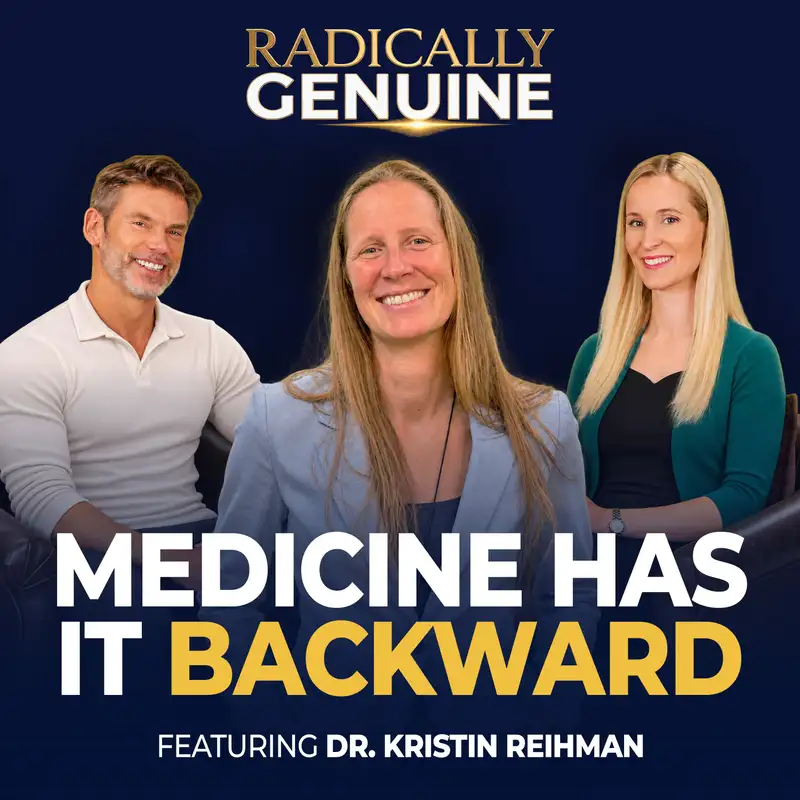
Doctor Kristen Reimann. Welcome to radically Genuine.
00:01:06:04 - 00:01:09:10
Speaker 2
Thank you. Roger and Tracey. It's so nice to be here.
00:01:09:12 - 00:01:28:17
Speaker 1
Let me throw a theory at you. It's my belief that the way we understand disease is, at the very least, fundamentally flawed. If not, our entire paradigm is wrong. Let's say you.
00:01:28:19 - 00:01:42:21
Speaker 2
We being the Western medical tradition in this sentence. Yes. Yeah, I, I think there's a lot of truth in that. And I've essentially spent the last 15 years operating kind of outside that paradigm for that reason.
00:01:42:23 - 00:01:48:03
Speaker 1
Well, how did you get to that place in your career?
00:01:48:05 - 00:02:09:00
Speaker 2
Well, I think it was always sort of in me to do something different. I went to medical school, actually, because I wanted to deliver babies and be a midwife, but I didn't feel like being a midwife would allow me the power to change medicine the way I sort of knew and intuitively that it needed to be changed. And I couldn't have described that for you at the time.
00:02:09:00 - 00:02:45:04
Speaker 2
I just felt like midwifery is where I want to be, but I'm not sure that's the right profession for me. So I went to medical school to become an ob gyn and deliver babies. I didn't end up becoming an OB, but I ended up delivering babies as a family doctor, and I always felt like birth was so medicalized and so pathologist that it wasn't really allowing birth to be what birth is supposed to be, which is most of the time safe and healthy and natural if we allow it to be.
00:02:45:06 - 00:03:14:06
Speaker 2
And I had two of my four kids during medical school with midwives. And so it was really sort of experiencing for myself what a healthy birth could be. So fast forward to about five years after that in residency, I got a tick bite and I got a bullseye rash. And for those who already know what is coming, you know, I got Lyme disease, and it wasn't a bad case.
00:03:14:08 - 00:03:35:21
Speaker 2
I took doxycycline, I was in residency. I was feeling great the whole time. I figured maybe I didn't have it. I just took some antibiotics, which is what I knew to do at the time and moved through it. And about four years after that, I became very, very ill. And that really changed the trajectory of everything.
00:03:35:23 - 00:03:57:20
Speaker 2
Did you associate becoming ill four years later with that tick bite? So it was interesting. I actually became ill before the second tick bite. And what happened was I was working in the inner city. I had a patient who was new to me. She was a lovely woman in her 50s. She had gotten a tick bite a couple of years prior and had not been the same since.
00:03:57:22 - 00:04:20:03
Speaker 2
And when she came to me and told me her story, she said, no doctor believes me. I'm sure I have Lyme disease and also Bartonella and baby. And these were these were infections I learned about in microbiology class, but had never had any sort of clinical context for that. We were sort of trained to believe, well, these are acute if they happen and there's lab values that are always associated with them and they get better with antibiotics.
00:04:20:03 - 00:04:37:13
Speaker 2
But no one ever really has these infections. But here she was saying, I've got a chronic form of these. What I now to be called Lyme co-infections, things that travel in vectors like ticks and mosquitoes, just like Lyme does. And she said, no doctor believes this. So if you're going to be my doctor, you're going to have to read this first.
00:04:37:15 - 00:05:00:03
Speaker 2
And she pulls out from her bag a stack of paper, and it was all things she'd printed off from her own research online, both on PubMed, looking at published literature, but also blog posts. You know, various websites. And as she pulled it out, all I could think of is this woman's not lying. This is her real experience, and she knows something I don't.
00:05:00:03 - 00:05:37:13
Speaker 2
And I need to read this. So I took that and I read it. And what I learned from those bits of paper was that Lyme disease is not easily treated in everybody with four weeks of antibiotics, is not easily diagnosed in everybody with tests that miss up to 60% of actual Lyme. The standard tests do is not well understood, and in many people can persist for years and years, including ten years after treatment with, you know, I've, you know, I've or I am sewn a gentleman gets a lime spirally cultured out of his knee.
00:05:37:14 - 00:05:58:11
Speaker 2
Ten years later, after what should have been, you know, complete treatment based on the sort of dogma. And as I was reading this, I was just overcome with kind of a mild panic like, oh my gosh, I've been missing this infection in. And patients were flashing before my eyes. I could see the people who I'd said, well, look, the lime test is negative.
00:05:58:12 - 00:06:21:11
Speaker 2
It must be something else. Maybe you go to rheumatology, maybe you go to infectious disease. Maybe we just send you to psychiatry. And I was realizing, wow, I've really been missing the boat. And the other thing that was sort of coming up for me as I was looking through that, was this realization that I'd been dealing with a lot of really vague symptoms that were, frankly, really, you know, causing a lot of suffering.
00:06:21:11 - 00:06:42:12
Speaker 2
But I'd sort of been pushing them under the radar, like I'd wake up every morning feeling like I'd been hidden by hit by a truck, and I had these little flickering thoughts of, is this what fibromyalgia is? Is this what chronic fatigue is? I didn't want to think about those things, because in the Western medical tradition in which I had been training and was currently working, those things are really sort of considered like a wastebasket diagnosis.
00:06:42:12 - 00:06:59:12
Speaker 2
Everything else gets ruled out. And then that's what you land with. And there's not there's no really great labs for those. It doesn't feel real. And patients get gaslit a lot and dismissed. They don't have good drugs for it. Anyway, I was thinking, I don't want that right. But as I was reading this, I was thinking, maybe this is what's happening to me.
00:06:59:13 - 00:07:18:06
Speaker 2
And at that time, I was about a year into my fourth child, early infancy. I'd been nursing that baby all night long, waking up all night long. I had understandable reasons to be exhausted, but my brain didn't feel like it was working very well. I felt like I would have to read things multiple times to get them, and so.
00:07:18:11 - 00:07:34:12
Speaker 2
And I had joint pain everywhere. I had pain syndromes basically, and I was having this light bulb go off for me as I read this woman's research, thinking, not only have I been missing this in all of these patients, but I've been missing this in myself.
00:07:34:13 - 00:07:37:11
Speaker 3
So what did you do next?
00:07:37:12 - 00:07:58:08
Speaker 2
So I spent a good deal of time crying and freaking out. And one night, my oldest son, he was about 12 at the time. He came in from outdoors. I remember this so clearly. It was in the kitchen. I was on the computer, and it was one of those moments where I'd been reading something again and again and again, trying to sort of retain it and just having this thought of, I need, I need to treat myself.
00:07:58:09 - 00:08:14:13
Speaker 2
I need to do what I have learned to do in the standard Western model to treat Lyme. I need to put myself on some antibiotics and wean my baby and just get on antibiotics. But I didn't want to wean my child out of fear and uncertainty, right? So my son comes in and says, mommy, why are you freaking out?
00:08:14:13 - 00:08:33:21
Speaker 2
Why are you crying? And I was like, I'm learning about Lyme. I think I have Lyme, I think I need to get on antibiotics. He's like, why don't you just get on antibiotics then? And in that moment, I realized, I'm not weaning my baby out of fear. I need another tick bite to convince me to wean my child and get on antibiotics.
00:08:33:23 - 00:08:56:19
Speaker 2
I had that thought. That night I went to bed, and it was only after taking a stroll through the through our yard with the dog. Took the dog out to pee. It was November. It was, post a snowstorm and an ice storm. So the the willow tree was hanging down, heavy with ice. And I remember brushing past the willow tree and it sort of scratching my back as I walked under it.
00:08:56:19 - 00:09:16:23
Speaker 2
And that's why I remember that. And then I went to bed and three hours later waking up to nurse. As was my habit at the time, I felt something and I reached down and pulled a deer tick off my butt. And three days later I had a bullseye rash and I got my wish.
00:09:17:01 - 00:09:18:18
Speaker 1
Do you believe that you called that to yourself?
00:09:18:18 - 00:09:35:06
Speaker 2
I do believe I called it in. It was to me so clear. I was so afraid. I said, I need this to happen in order to move forward in this journey. And three days later, in the middle of winter, essentially, I had my I had my next step.
00:09:35:08 - 00:09:36:16
Speaker 1
Take us from there.
00:09:36:18 - 00:10:02:22
Speaker 2
So I weaned my kid, I got a doxy cycle, and I actually put my child on amoxicillin, because I had learned at this point that Lyme disease is transmissible. They found it in human breast milk. They found it in human semen. They found it in placentas of miscarried babies. It's transmissible. And I wanted to protect him. And so I thought, microbiomes be damned, I'm just going to kill this thing, because that was the mindset I was coming from at the time.
00:10:03:00 - 00:10:24:21
Speaker 2
I no longer have that mindset, but it was clear to me that fear had been a part of calling it in. And so quickly I was working to work on the fear. Took a long time to move out of that fear because, you know, when you're learning something new and you feel terrible and the stakes feel really high and, and the, the medical establishment that was my tribe at the time wanted nothing to do with my thoughts on this.
00:10:24:23 - 00:10:43:17
Speaker 2
Like they thought I was crazy for treating myself for an extended period of time, for treating my baby, for, you know, the idea that I called this in. I might not have shared that with everybody. But I felt really outside of my tribe. I felt very it was it was a, you know, we talk about dark nights of the soul.
00:10:43:17 - 00:11:05:18
Speaker 2
And I feel like that was the beginning for me of a real a year of a dark night, just feeling very outside of, you know, outside of the guidelines, right outside of the standard and alone in that and threatened, you know, I felt like I used to liken it to it feels like I'm a witch. And I'm walking around through the hospital looking behind me to make sure no one's scattering kindling.
00:11:05:19 - 00:11:07:02
Speaker 2
Like that's what it feels like.
00:11:07:03 - 00:11:24:14
Speaker 1
Wow. Well, let's talk about your tribe for a second. You went to premier American institutions. Yale undergrad, Stanford Medical. What is the prevailing viewpoint on infections, for example?
00:11:24:16 - 00:11:42:21
Speaker 2
Well, it's been a while since I was in both of those places, but, based on what we all lived through for the last six years, I could tell you that it hasn't changed much, that there's really a focus on targeting the infection when someone has an infection, as opposed to building up the person who might then not get sick from an infection.
00:11:43:00 - 00:12:02:04
Speaker 2
I mean, we've always known that there's a certain penetrance of disease. A disease might come to a town or a party or a gathering, and not everyone gets the disease right from the infection. So I've always been really, really curious about what's what's happening with those people who don't get sick. Like, what are they doing differently? How do we do what they're doing?
00:12:02:09 - 00:12:18:15
Speaker 2
I remember learning this at Stanford two, as we were learning about HIV and learning that there are people not only who get HIV, HIV and don't die from it, but they don't get sick from any of the things. I mean, there are a handful of people, and there were people at Stanford at the time studying those people, and I was super fascinated by that.
00:12:18:16 - 00:12:41:05
Speaker 2
Like, what's happening with those guys, right? That they're not actually going down with these things, that we're all afraid of taking us down. So the prevailing, the prevailing thought is still that we focus on the pathogen. Right? That's what vaccines are about. That's what medicines are about. Typically in the standard canon right now, other schools of thought, other medical branches.
00:12:41:06 - 00:13:05:09
Speaker 2
I mean, homeopathy is really about shoring up the body. Herbs and things are also about supporting detox pathways, supporting your immune function, supporting your digestion, supporting your mental health and all these different ways so that your terrain, you know, the part of you that involves your detox pathways, your immune system, your thoughts, those are all clear and clean and less hospitable to allowing pathogens to grow and thrive.
00:13:05:10 - 00:13:09:05
Speaker 1
Do you subscribe to train theory?
00:13:09:07 - 00:13:25:22
Speaker 2
People like to make this big dichotomy between terrain and germ theory. I mean, I believe in germs. I believe they exist. I also believe the terrain is really important. I mean, it's pretty clear to me that the patients who come to me, who work on their terrain, tend to not have to deal as much with killing the pathogen.
00:13:26:02 - 00:13:49:22
Speaker 2
I mean, I wrote a whole book on how to recover from Lyme, naturally, and I don't even get to killing bugs until chapter nine, because every other chapter is about how do you clean up your mindset about this? How do you sort of fear, how do you make decisions about whether you actually want to survive this? Like, those are all so key and crucial to killing the pathogens and getting, you know, restoring balance so that you're not feeling ill from whatever you're carrying.
00:13:50:00 - 00:13:53:19
Speaker 2
That I put that almost last in the book.
00:13:53:21 - 00:14:14:16
Speaker 3
So you spoke here about, you know, how do you decide if you want to survive this? That's an interesting statement to make, because I would think that for many people who are sick, that doesn't actually occur to them to to ask if they want to survive it or not. There's kind of this assumption that, well, of course we do, but it sounds like you think that may not always be the case.
00:14:14:18 - 00:14:41:02
Speaker 2
Yeah, I think it's a crucial question. And I it's, you know, right up front in my book because to me it's where you start as a, you know, as a doctor, I feel like many times I'm more like a coach. I'm really trying to help people identify what their goals are vis a vis this illness or this challenge or this decision around interventions, and then help them remove obstacles so that they can make decisions that are in alignment with their own goal.
00:14:41:04 - 00:14:56:09
Speaker 2
Right. And early on, even in my journey, I had to get really clear on my goal of wanting to live. And so I just think it's it's a really important piece. I mean, these complex illnesses, people often feel like they're dying. Sometimes they do die.
00:14:56:11 - 00:14:57:22
Speaker 3
Did you feel like you were dying when you were.
00:14:57:22 - 00:15:17:11
Speaker 2
Saying, I did, I really did, yeah. And it wasn't this that wasn't the first tick bite, which again, that felt that was a breeze. That was a nothing burger. It was the second tick bite that caused me to have to go through this whole fear moment and then finally get on antibiotics, finally get better. I mean, three months later, I was I was better, I was back to I was like, back to work.
00:15:17:12 - 00:15:35:07
Speaker 2
I worked that whole first three months. I was sleeping 12 hours a night, but I was working and I was, you know, working through whatever I needed to work through. But I wasn't, I wasn't really well yet. After three months, I felt like I'm well enough. I can get off the antibiotics. And I felt okay for a month.
00:15:35:09 - 00:15:55:02
Speaker 2
And then one day I woke up an every single symptom was back and a new one, which was excruciating sciatic pain. So one of the things that I'm bacteria, which is a little spiral organism called the spiral, does is it kind of burrows into places that are immunologically privileged, which means your immune system has a hard time finding it.
00:15:55:02 - 00:16:12:13
Speaker 2
It's how it creates long lasting kind of chronic stealth infection. And I had had back surgery as a teenager when I needed a disc, and I was a competitive swimmer, and I was very eager to get back in the pool, and that was the option given to me. And I said, heck yeah, I'll take surgery and be back in the pool in two weeks.
00:16:12:18 - 00:16:36:16
Speaker 2
And so I had surgery and I had this, you know, scar in my back and in this sciatic nerve that had been injured when I had that back surgery the first time. And suddenly I had all that pain back. And I, I felt like intuitively, this is probably Lyme that's now found its way. I, I drove it into hiding with the antibiotics, and now it's probably hanging out in my sciatic nerve and I couldn't get out of bed.
00:16:36:18 - 00:16:57:06
Speaker 2
I ended up in the hospital for a week with trying to get pain under control. It was a total chaos moment. I mean, I was, I was. I had a heating pad that created a burn, a second degree burn. I just couldn't get comfortable. They finally put in a a patient PCA, like one of those things with the patient can control the delivery of an opioid.
00:16:57:06 - 00:17:18:09
Speaker 2
I was on Dilaudid. I nearly overdosed myself on Dilaudid. They had to bring in the crash cart. It was just craziness. It was crazy town. And even with all that, I didn't get, well, I went home on a lot of medication, and I lay in my bed for five weeks, and I lost 30 pounds that I didn't really have to lose.
00:17:18:10 - 00:17:37:12
Speaker 2
And I checked out. I was checked out, and, I had met a woman prior to this who invited me. She heard I was doing really poorly, and she said, why don't you come to my office? I will, I'll do some. I'll do what I do. I'll listen to your story. I'll maybe give you some homeopathy. And I was like, look, I don't believe in that.
00:17:37:12 - 00:17:54:12
Speaker 2
But whatever you think will help, I'll. I'll try it. So I went to her office and I lay in her couch, and I told her my whole story. And at the end of like a two hour session, she was like, great. Well, I think you found your remedy. I'm going to go whip it up for you. So she, like, bustles off into her kitchen like makes homoeopathy in her kitchen.
00:17:54:12 - 00:18:10:08
Speaker 2
And I'm just lying in the couch kind of with my eyes crossed, going, what? What even just happened? I don't think she can help me. I feel like I'm not even here. I feel like a shell of my former self, like I'm not present. And she came back in and she sat down and she said, okay, here's your here's your remedy.
00:18:10:09 - 00:18:31:15
Speaker 2
Please take this every day, three times a day. And, you know, text me tomorrow and let me know how your pain is. And I was like like my pain. My pain isn't even the worst of it. And this woman who'd already spent hours with me, like, sat down again and looked at me and said, what's the worst of it?
00:18:31:17 - 00:18:48:13
Speaker 2
And I said, I feel like I'm dying. I feel like my body is trying to die. I feel like I have to think about breathing in order to make myself take a breath. And what I hadn't told her is that my mom died about, you know, the year I was I was turning 42 that spring, and she died at 42.
00:18:48:14 - 00:19:05:01
Speaker 2
Left for kids behind. I had four kids. I'd always thought as a child. Oh, I guess I'll have four kids and died. Like, I didn't even question that. And then, of course, I got to my adult life. I had some babies and I was like, well, that's not me. Of course that's not me. But I realized in that moment that like, no, I'm still this.
00:19:05:01 - 00:19:28:22
Speaker 2
I'm still playing off this script like I'm my body's trying to die. And I told her that and she said, well, you know, that was your mom's decision. That was her journey. What is your decision going to be? Are you trying to live or are you trying to die? Because it makes every bit of difference in terms of how I support you on this journey.
00:19:29:00 - 00:19:37:07
Speaker 2
And that blew my mind. And then she was like, text me tomorrow and let me know what your decision is.
00:19:37:09 - 00:19:51:03
Speaker 2
And I got home and I thought, well, that's really the only question that matters right now, because if I'm not aiming at the thing, I think I'm Amy and of course I'm not going to get there. So I lay in bed and I thought about that decision, and I was like, how do you even make a decision like that?
00:19:51:03 - 00:20:08:02
Speaker 2
And I said, well, how do you make any decision, Kristen, you think about the path, one choice of the path and the other choice, and you think about how you feel. You feel the feels of what you would imagine feeling on that path. And I was like, okay, well, I die, and I had no emotion, no emotion. And I was like, that's interesting.
00:20:08:03 - 00:20:25:17
Speaker 2
It was kind of like observing that, wow, I don't have any emotion about dying. And I think it's because my family had already processed my death. I had been downstairs a couple days prior, and my husband had said to me, hey everyone, mom's down for dinner. And I was like, what are you talking about? He goes, what are you talking about?
00:20:25:19 - 00:20:43:22
Speaker 2
You haven't been down for dinner or any meal in five weeks. And it hit me. In that moment, I was like, whoa, you guys must have all thought mommy was upstairs in her bed dying or something, kind of making a joke about it. And they all nodded and looked down at their plates and I was like, oh my God, I've I've done it.
00:20:43:22 - 00:21:00:20
Speaker 2
I've I've killed myself off. And I said, who really thought, come on, guys, who really thought mom was dying? Everybody raised their hand except for one. I later asked him, why didn't you raise your hand? Goes, I knew you'd never do that to me. But everyone else was like processing my death.
00:21:00:22 - 00:21:03:10
Speaker 1
Wow.
00:21:03:12 - 00:21:15:21
Speaker 2
So I believe it's an important choice. And I believe we have to make it before we can have any kind of success moving towards whatever our goal is.
00:21:15:23 - 00:21:19:16
Speaker 1
Why do you believe you got sick?
00:21:19:18 - 00:21:40:22
Speaker 2
I have lots of theories about it. I don't pretend to know the final answer to that, but I do believe that it's part of my path and my purpose to teach people who get sick for them from the same things that I've been sick from or injured, how to recover, how to find their own inner rock star again, how to get back to leaving a full life of vitality.
00:21:41:00 - 00:21:59:14
Speaker 2
I've had a lot of little, little. I've had a lot of quasi near-death experiences, and every single one of them has felt like a gift in the end, because I come away with so much knowledge and understanding, and I'm very grateful for all of those things.
00:21:59:16 - 00:22:05:22
Speaker 3
How has this changed how you approach your patients and the challenges they face?
00:22:06:00 - 00:22:11:12
Speaker 2
I think it's made me more effective, more compassionate.
00:22:11:14 - 00:22:32:01
Speaker 2
I used to collect people who had mystery illnesses in medical school and residency. They would come to me and find me, and I didn't feel like I had any tools to offer them. So I would just sit and listen and validate their suffering and say, I'll do my best, I'll try to learn, and I would, but I didn't feel like I could help them.
00:22:32:01 - 00:22:53:01
Speaker 2
Really. In retrospect, of course, I know that was helping them tremendously, right? To see them and see them as whole and healed and and help them imagine that for themselves. And even if we were uncertain about how to get there, I was always doing that. So I don't think it's changed that. I think I came with that. I think it's just brought me to a lot more tools.
00:22:53:03 - 00:23:08:12
Speaker 2
It's allowed me to help a lot more people, because when you have a tool, you know, when you tell people, I'm really good at being with you and sitting with your suffering, like that's not really something that people want to come find you for, right? They're like, well, give me the thing. Give me the what's your intervention? Right.
00:23:08:13 - 00:23:20:02
Speaker 2
So having a toolbox is really helpful. Although between you and me and I guess whoever's listening, I really do believe that the intervention is just being present for people and loving them.
00:23:20:04 - 00:23:29:05
Speaker 3
And of course, as I'm sure you're well aware, there's a lot of talk about whether Lyme disease is a naturally occurring.
00:23:29:07 - 00:23:53:05
Speaker 3
Disease or whether it was a bioweapon. There's the book bitten, which I'm sure you you've been you're familiar with. There are these whistleblowers who have come out and basically said this was developed as a bioweapon. It was intentionally released. We've studying in these laboratories, and, it's its impact is not natural. I've been down that rabbit hole.
00:23:53:05 - 00:24:07:06
Speaker 3
I suspect you have two. And I'm curious what what you think about that now, whether you think it's there's potentially truth to it. And how does it impact, the the experience of somebody who may have Lyme. Yeah.
00:24:07:08 - 00:24:24:10
Speaker 2
Well, I think it can be very fear generating and that's what it was for me. So part of what was happening when I was sitting at my computer and my 12 year old walked in and was like, why are you freaking out? As I was down those rabbit holes I was learning about, like the sort of history of Plum Island, the history of development of, you know, the weaponization of ticks by the military.
00:24:24:10 - 00:24:39:15
Speaker 2
And I was just like, this is too big. I'm up against too much of a I mean, again, I was already feeling like an outsider in my tribe. I felt like there was no safety anywhere. And I just decided that at that point, I'm not going to solve that problem or even maybe even figure all that out for sure right now.
00:24:39:20 - 00:25:03:01
Speaker 2
But what I do know is it's stirring up a ton of fear, and that is not good for my immune system or my healing. So I just compartmentalized it. I said it aside, and I actually teach patients to do that. Now. I say, listen, you're not going to solve that problem. You're not going to become the most effective advocate for this change that you'd like to see in the world right now until you're physically and mentally well, like, let's get you there and then you can go and, you know, march on whatever prey you need to march in, right?
00:25:03:01 - 00:25:13:03
Speaker 2
Whatever legislation you need to write, write a book. But right now we have to focus on you getting well. And if fear is coming from all that research, it's not on your team.
00:25:13:05 - 00:25:17:04
Speaker 1
So how did you get yourself? Well.
00:25:17:06 - 00:25:37:18
Speaker 2
Well, that's a multifaceted, multi-step process. But I think it started with deciding I wanted to live. And the way that conversation went in my bed that night, it didn't resolve the question immediately. Like, I didn't know right away what my answer was like. I thought about, well, I could die. And then I pictured all my kids doing their thing.
00:25:37:18 - 00:26:01:20
Speaker 2
I'm like, look, my husband's been managing this. He's going to find another partner. He's going to do great. They'll all be fine. Like, they know I love them. They're already fine. And I'm they think I'm dead. And then I thought, well, I could also live. And again, there was no like, rush of emotion, which for me is very strange, but there was a really clear sense of if you're living, you are not living for any fear.
00:26:01:23 - 00:26:24:19
Speaker 2
There's no more fear about Lyme or what you know, or what you're up against, or what the government might have done to ticks like none of it. You're not living for fear there will be no fear. There will be only joy. Jumping on trampolines, running through fields, gardening, saving the world and love. That's it. There's no there's no there's no that's that's what the conditions are for living.
00:26:24:21 - 00:26:51:07
Speaker 2
And I was like, wow. Well, that's pretty clear. But I don't have any emotion. I don't really know what I'm feeling. So I went to bed. Next morning I woke up, I had the same conversation in my bed because my bed was my office. I was only in bed now. I did have physical therapy that day. Once or twice a week I would get on a little bus and go to physical therapy and move around in a hot pool and try to manage the pain that way, but I, I didn't really spend any other time out of bed.
00:26:51:09 - 00:27:10:13
Speaker 2
So I was lying in bed and I had the same conversation. Well, I could die. I could live not feeling it. All of a sudden I was like, I'm in the hallway. How did I get in the hallway? Next thing I know, I'm downstairs in our endless pool in the basement. First of all, it was treacherous. Anyone who visited my house in those days would be like, this is not to code.
00:27:10:15 - 00:27:30:02
Speaker 2
And you'd have to, like, leap over a table and climb up into the pool and then, like, lower yourself. And somehow I was swimming in the endless pool, and I was like, how did I get here? What is going on? Interesting. So I, you know, feebly swam around for seven minutes or something, and then I got out and the next thing I know, I'm eating breakfast in the kitchen and everybody's like,
00:27:30:07 - 00:27:47:23
Speaker 2
What are you doing here? I'm like, I'm eating breakfast. I don't really know. Then I got on the bus. I went to my physical therapy still, like kind of mentally trying to figure this question out, wrangling with it, trying to feel the fields, trying to do all the things and got back from physical therapy. And instead of going into the house, I went out to the garden and I sat down on the bench.
00:27:48:02 - 00:28:06:13
Speaker 2
We had a little community garden we built with friends, and I was sitting on the bench and I looked and noticed that the redbud was blooming. I was like, oh my gosh, it's springtime. I haven't been outside in months. The redbud is blooming. And then I was like, what am I doing? This is not how dying people behave.
00:28:06:15 - 00:28:28:19
Speaker 2
This must be. This must be what me making a decision to live looks like right now. So I pulled out my phone. I texted the homeopath. I was like, Melinda, I don't really know if this is right, but I feel like my body is deciding to live. And she wrote back. Great, great news, Katie posted. And it just was like little steps of me being kind of, kind of in wonder.
00:28:28:19 - 00:28:48:20
Speaker 2
I was in wonder that night when I got into bed and I was like, oh my gosh, I've not been in bed all day. I've been cheating on this bed with life all day. And I wasn't out of pain. I was still in terrible ten out of ten pain intermittently in my back, in my leg. And when that happened, I would just drop to the floor and lie down and reset things for a few minutes and then feel a little better get up.
00:28:48:23 - 00:28:56:16
Speaker 2
So still in a lot of pain. But I was not suffering. The suffering was gone and I was like, wow, that's interesting.
00:28:56:18 - 00:29:02:21
Speaker 3
How would you define the difference between pain and suffering?
00:29:02:23 - 00:29:22:12
Speaker 2
It's funny, the first thing that comes to mind is I would define it as this crease that I made in my forehead permanently for seven months of doing this. You know I have it. There still is a little reminder. Didn't have that before the suffering. I just wasn't in my head about it. I wasn't thinking all the time of like, why am I still in pain?
00:29:22:12 - 00:29:44:19
Speaker 2
What do I still need to do? What's this about now? I still ask those questions, but it wasn't like it was more of like an observer. Observer like, I wonder, as opposed to what's going on that I can't heal, you know, with that judgment? It was more of a curiosity, and it didn't reflect in worse pain or tension in my body or spinning of thoughts that were creating so much.
00:29:44:20 - 00:29:49:12
Speaker 2
I mean, I was crying myself to sleep every night until this happened.
00:29:49:13 - 00:30:17:09
Speaker 1
Proud to announce that my book is now available. The awakening they cannot medicate. It's an exposing the anti-human agenda behind the mental health industry and more importantly, reclaiming our own abilities to transform and heal. It's full of stories of my awakening, and the goal is for a paradigm shift, a paradigm shift to alter the way that we understand the human experience, that we can heal and help each other.
00:30:17:14 - 00:30:52:05
Speaker 1
Go to doctor mcfarlane.com or Radically genuine.com. It's also available on Amazon or wherever you buy your books. In my field there's a theory of pain called the gate control theory of pain. And to summarize it, it's where we put our attention. So the research in this shows that, you know, those who are focusing on their pain, like opens up a gateway where like the nerve endings are the experience to the brain and your experience of pain is very intense.
00:30:52:07 - 00:31:08:03
Speaker 1
And so subsequently, the comparison groups are any types of intervention that shifts attention away from pain could be some form of like mindfulness or meditative practice on something else getting busy. You know, doing something.
00:31:08:05 - 00:31:12:03
Speaker 3
Like touching your touching your skin somewhere else and drawing your attention to that.
00:31:12:05 - 00:31:34:06
Speaker 1
I'm not sure if that's in the in the studies, but it's just it's basically focusing on what interventions shift attention away from what that pain is, and the measurable differences between where when somebody is focusing on pain versus their attention, it's somewhere else are so dramatically different that it really begs us to enter into the conversation about attention, consciousness and creation.
00:31:34:08 - 00:32:12:02
Speaker 1
And so we did open this up about a paradigm shift, like a fundamental flaw in the way that we understand the human experience. When you studied at Stanford, what degree were you taught on this holistic nature of the human experience and more than just body parts? Where have you grown and understanding what the process of health actually is, and where is your field really, really off right now?
00:32:12:04 - 00:32:44:12
Speaker 2
When I was at Stanford, I remember imagining a pie chart, and that pie chart represented all that is known about how to heal. And I remember thinking that there was this little tiny sliver down here kind of at the 6:00, 7:00 position that represented not the stuff I was learning in medical school. And all the rest of the pie was like, all of this, I mean, and it feels that way when you're in medical school and in training, because papers are being published every day, different journals, more than anyone could ever take in.
00:32:44:13 - 00:33:05:04
Speaker 2
Right? There's all this sort of knowledge being generated that feels you're taught to believe, is non-biased, is accurate, is moving, moving forward. What we know, what is known about medicine and about healing? Most of it's about drugs and interventions that aren't about the innate body's healing capacity. But I and I knew that. But I also felt like.
00:33:05:04 - 00:33:27:09
Speaker 2
But there's still a lot of good stuff here, right? I that pie chart is inverted for me now. I think what I learned at Stanford was this, this little tiny wedge and everything else is what I'm exploring ever since. So I can't speak to the state of things there. Now, I will say that even when I was there, there were students who had.
00:33:27:10 - 00:33:49:04
Speaker 2
And it came from the students who had put together. Electives. And I actually put together when I put together one on medical hypnosis, I had an attending in psychiatry psych consult liaison, who was a former Catholic priest who had done exorcisms, had a very interesting backstory, and he also knew hypnosis. And I begged him to teach us hypnosis, put a course together.
00:33:49:04 - 00:34:13:17
Speaker 2
So we had that. We also had a course on alternative medicine. It was called Cam practices at the time, Complementary and Alternative Medicine, because, you know, it was only this part of the pie. So it was all complementary and alternative. Maybe you think about it, if this doesn't work, and there was a woman who put together a course called Teach Us How to Heal, and she brought in patients and they were probably my future patients, were probably my people.
00:34:13:18 - 00:34:28:17
Speaker 2
Right. I didn't take that course, but I was at a conflicting time for me. But it was called Teach Us How to Heal, and she would basically bring in patients who had had complex medical journeys and and interview them on their learnings. Basically. What would you like future doctors to know about what this has been like for you?
00:34:28:17 - 00:34:51:04
Speaker 2
So there were pieces there that people could pick up and find they weren't part of the standard curriculum. And I, I have I have two beloved people right now in medical school and residency. And so I'm always eager to know what's changed. Not a whole lot, as far as I can tell. I mean, there is a canon to get through and that that canon is heavily subsidized by the pharmaceutical industry.
00:34:51:04 - 00:34:58:17
Speaker 2
And they I mean, they subsidize medical training as well. So it's you kind of have to do those pieces if you're going that route.
00:34:58:19 - 00:35:03:06
Speaker 1
Can we do a true false exam before we move forward here on this? Sure.
00:35:03:08 - 00:35:05:03
Speaker 2
What percent do I have to get right to pass?
00:35:05:05 - 00:35:17:08
Speaker 1
Well, there's really no right or wrong. I just want to get your viewpoints on it. I believe human beings, evolved, are interconnected with all of nature. True or false?
00:35:17:10 - 00:35:18:12
Speaker 2
True.
00:35:18:13 - 00:35:27:13
Speaker 1
And does our our our our health should be viewed in the context of everything that we're exposed to?
00:35:27:15 - 00:35:29:12
Speaker 2
Well, should I get caught up on a should.
00:35:29:17 - 00:36:24:11
Speaker 1
All right. Take that away. When when understanding health an important variable or variables to examine is our natural environment. True human beings are energetic. True human beings are spiritual. True emotions. Thoughts are energy. True relationships matter and health true. Okay. So if we've established that all of those things and we're thinking about that pie chart, right. And we're trying to understand disease, all of those things that I just mentioned, how powerful are they in understanding when a person may have a specific disease or condition as far as root causes?
00:36:24:13 - 00:36:42:10
Speaker 2
Oh, well, they're incredibly powerful and they're often overlooked. I mean, there is a there's a place in medical training. There's a there's a place in medical interview where you learn in training how to ask questions. And one of the questions you ask is about social history. You know, what kind of house do you live in or kind of space you live in?
00:36:42:10 - 00:37:09:22
Speaker 2
Are you housed or not? Do you have are you safe in your home? Is there mold in your home? Is there are there dangers to you if you have certain inabilities to to move through your space? And who do you live with? Those kind of things. And that to me was the most interesting part of the history, because you can get at some of these things, you can get at what do you believe in, where do you think your strengths are like, do you have a do you have a spiritual community or do you have a healing team?
00:37:09:23 - 00:37:35:08
Speaker 2
Do you have people in your life who you trust who are part of this process for you? And I would spend an disproportional time of my interview talking about those things with people, because to me, those things are where you really get at the person as a whole, as a whole being. And I would get a lot of negative feedback from my attendings for spending so much time there.
00:37:35:10 - 00:37:37:19
Speaker 3
So they would see it as a waste of time.
00:37:37:21 - 00:37:57:03
Speaker 2
I don't think. I think if you ask them as a person, they would say no. Those are all very important, Kristin. But we, you know, given the context and the timing of what we have to do here and the sort of the time limited nature of the engagement, you don't you can't spend that kind of time. So I would go back afterwards and talk to patients about those things, especially when I was on service in the hospital and I was following patients.
00:37:57:03 - 00:38:13:13
Speaker 2
I was responsible for their care. For the period of my time there. I felt like not knowing those things was a huge disservice, right? It also made the interactions with the team much better. If they felt like they had someone on the team who actually saw them and cared about them as a person, but I had to do it on my own time.
00:38:13:15 - 00:38:20:19
Speaker 1
We recently did an episode titled it's not what you what?
00:38:20:21 - 00:38:24:07
Speaker 3
You don't get what you want, you get what you believe.
00:38:24:09 - 00:39:06:12
Speaker 1
And so it was really examining some of the scientific literature on the power of what you believe. So what we actually hold in consciousness, and it was on the theory, the premise that we are creator beings, that we are living in a universal field that has universal laws, and in those universal laws is what we create inside, internally, in the mind, with our thoughts, our emotional experiences, our energetically interacting with the universe that brings it back into into form so that we are ultimately really just.
00:39:06:12 - 00:39:35:21
Speaker 1
We are fragments of a, of a great creator, and we're mostly doing it unconsciously. So we're absorbing consistently this understanding of who we are in relationship to the world. So we might learn very early on that our opinions don't matter. In some cases, we're just unlovable or we don't deserve certain things. And this is an emotion. This is an energetic experience internally that is brought back to us in its physical form.
00:39:36:03 - 00:39:58:13
Speaker 1
I ultimately see it as a holy experience, something for us to overcome. But even from the psychological literature, if you're just a materialist, you can say, well, our attention is limited, and so we're going to focus on our attention is going to be focused on the things in which we believe. So the confirmation bias, for example. So we might just dismiss any other evidence that shows our opinions do matter.
00:39:58:13 - 00:40:27:10
Speaker 1
And, you know, we are lovable and people do like us, and we do have this amazing power to achieve and attain great things in life. But because we have these core beliefs, it filters all that other information out. So we're getting back to us pretty consistently and living a life exactly what we believe. And then we see this in medicine, the placebo effect, the no Sibo effect, like what you believe manifests itself into physical form.
00:40:27:12 - 00:40:34:14
Speaker 1
Yet it is, I don't want to say completely ignored by your profession, but it's certainly not utilized in the least bit in contemporary medicine.
00:40:34:15 - 00:40:53:09
Speaker 2
No. Agree. It always drove me crazy when people would say, well, well, that's just placebo. I'm like, and it was free and there were no side effects. Like, can't we harness that? Like, wouldn't you rather be taking a sugar pill and just have a placebo effect and still be completely, you know, transformed by it, then taking something that has side effects and cost you money?
00:40:53:11 - 00:40:54:11
Speaker 2
Yeah.
00:40:54:12 - 00:41:16:21
Speaker 3
So I was very interested to hear you talking about the role of fear, with with Lyme disease and disease in general and how it might bring it into a person's life, how you believe it did bring it into yours. In that moment when I was seven, I had I had Lyme disease. Now, I wouldn't say I called it to myself unless it was an agreement I made before I came into this life.
00:41:16:21 - 00:41:39:07
Speaker 3
I didn't know it existed. I was a seven year old child. I get a bullseye rash, I know nothing about it. And suddenly I'm very, very, very sick. And I continued to be ill for years afterwards. But, you know, Roger was just talking about the role of belief and how we play it out. And I realized as a child I had parents who loved me, but they were also extremely busy.
00:41:39:07 - 00:42:12:21
Speaker 3
I was put in daycare when I was six weeks old. I was one of nine kids. There wasn't a lot of time and attention, and when I was sick, I did get attention from my mom and I do. You know, I continued to be quite ill for years afterwards, and I genuinely wonder, to what degree did I believe, I was lovable when I was ill, and because otherwise I didn't get that much time with them other than when I was in trouble because they were just so busy with with all these kids who were younger than me.
00:42:12:23 - 00:42:53:12
Speaker 3
And so I continued to be quite ill for much of my childhood. And I genuinely wonder to this day how much of that was because I believed at some level that that that was, that was where I was able to be loved. In my adulthood, I was, you know, I was I was sick as well. And. I wish someone had told me what your homeopathic friend said to you when I was sick for all these years after my vaccine injury, because it didn't even occur to me that me making the decision and and believing that I could and should get well might be what was holding me back.
00:42:53:13 - 00:43:08:02
Speaker 3
I now believe that that was a huge piece of it. You know, I ended up making a deal with God. If you heal me, then I then I will devote my life to doing what you asked me to do. But before that, I was believing the doctors who told me I could not get well. And so that was the limit.
00:43:08:02 - 00:43:26:12
Speaker 3
I was sick, period. That's just what it was. And I wonder what the impact would be if more patients knew they needed to make this decision for themselves and that they could get well, the degree to which their mindset influenced it.
00:43:26:18 - 00:43:42:22
Speaker 2
Right? Well, you said so many things there. I want to comment on so many of them. So the first thing I want to say is if it's true and I don't pretend to understand if all disease is comes from belief, I don't know if that's true. I just know it has a profound impact in a lot of my patients and in me.
00:43:43:00 - 00:43:55:23
Speaker 2
But if it's true that you subconsciously pulled in illness so that you could have attention from your parents, what a powerful creator you are to get your needs met, right?
00:43:56:01 - 00:43:58:21
Speaker 3
Yeah, that's one thing. I hadn't looked at it that way.
00:43:59:02 - 00:44:12:14
Speaker 2
You created a powerful intervention to get your needs met for care and attention. It served you. It's amazing.
00:44:12:16 - 00:44:38:12
Speaker 2
The other thing I'll say is, I sometimes wonder to what degree are beliefs that draw experiences to us. I'll just speak for myself. To what degree my own beliefs draw things to myself, versus the beliefs that are like sticking to me with Velcro from other people. And some of those beliefs I'm aware of, right? Some of them are the things that my grandmother believed and I sort of took on as a kid, and I'm now like, oh, wait, do I actually believe that?
00:44:38:12 - 00:44:57:14
Speaker 2
Or the things that my dad believed? And I'm like, oh, is that serving me? Maybe that's not mine. But I've also learned over the last several years that we walk around imagining that we don't take on other people's stuff, but we take on other people's stuff and they take on our stuff, and it's invisible, and we don't always feel it.
00:44:57:16 - 00:45:19:05
Speaker 2
But you walk down the street and you're like a magnet. And I think the more the less we do our own work and create our own boundaries, the more and forget to do our sort of energetic hygiene, the more stuff we accumulate. So I believe it's quite possible that you also carried someone else's belief or fear about Lyme disease or whatever.
00:45:19:06 - 00:45:21:17
Speaker 2
Whatever else you got later, right? It wasn't yours.
00:45:21:18 - 00:45:36:14
Speaker 3
Yeah, I mean, this was early 90s, and I know in the in the community where I was living at the time, it was still basically unknown. Nobody really knew what existed. There was a local doctor who had just gone and done a training about it, and he was the one that actually spotted the rash on me because we were neighbors.
00:45:36:14 - 00:45:40:02
Speaker 3
And he was like, I just learned about this. Is that a bullseye rash sticking out of this kid?
00:45:40:03 - 00:45:42:20
Speaker 2
How fearful was he of lime coming to his community?
00:45:42:22 - 00:45:46:02
Speaker 3
I would assume that he was probably quite fearful and he was my next door neighbor.
00:45:46:03 - 00:45:46:23
Speaker 2
So that's what I'm saying.
00:45:47:03 - 00:46:11:10
Speaker 3
Interesting. Yes, we're pulling out the collective field. Yeah, yeah. I mean, I had had many, many, many tick bites before that. I remember my mom pulling him out of me all the time, but that, you know, I do know for a fact that he had just had this training about it and that he was my neighbor. So I used to be really afraid of of ticks, terrified of ticks in my adulthood because of this, understandably.
00:46:11:11 - 00:46:29:15
Speaker 3
And, you know, I knew people who had neurological Lyme that were in states of some level of paralysis doing terribly. And so I spent years not going outside into a grassy area anywhere like that without, you know, the the light colored pants, the permethrin treated gaiters. I mean, I was obsessive about it because I was like, I'm never getting this disease again.
00:46:29:15 - 00:46:53:03
Speaker 3
But it it took up a lot of my consciousness. I've now stopped doing that. And it's not that I don't think there are people who get Lyme disease. I've just personally decided to change my own relationship with it, because it was generating so much fear in my life, and it was keeping me from interacting with the beautiful natural world and the way I would have wanted to.
00:46:53:06 - 00:46:57:01
Speaker 2
And I would. I would posit that it was also putting you at risk for another tick bite.
00:46:57:02 - 00:47:11:12
Speaker 3
I'm sure it was. I'm sure it was. And I got a tick bite this spring. In past, I would have pulled that tick. I would have sent it to the state lab for testing, you know, here in Pennsylvania to find out if it was carrying anything. This time. I just flushed it down the toilet and I did nothing.
00:47:11:12 - 00:47:31:19
Speaker 3
And I was, you know, it was my ankle itched for, like, a week, and then I was fine. Which is a huge, huge shift for me and how it handle this. And, you know, I was just recently reading autobiography of a Yogi para Hamsa Yogananda, which are you're familiar with this book as well. Amazing book.
00:47:31:21 - 00:47:32:08
Speaker 2
And in.
00:47:32:08 - 00:47:55:12
Speaker 3
It, you know, he's living in India where mosquitoes are as dangerous as ticks. They carry malaria and they can make you very, very sick. And so he had never slept under except under a mosquito net for, you know, avoiding these bites. And he's living with his guru who is refusing to sleep under a mosquito net, finally gets him to agree that that he can buy some.
00:47:55:13 - 00:48:28:10
Speaker 3
But one night he says to his guru, like, look, why, why, why can't I sleep under a mosquito net? I'm getting bitten alive. And his guru says, why don't you just give up mosquito consciousness? And so he goes back to his bed. He decides to give up mosquito consciousness, and he's never bitten again. And as somebody who used to be utterly terrified of tick bites and has now decided not to be, this just instantly stood out to me because it's something that I've seen so many people get sick from.
00:48:28:12 - 00:48:34:02
Speaker 3
And I wonder, is this an option for the rest of us?
00:48:34:04 - 00:48:53:19
Speaker 2
Yeah. I mean, I love that story, and it's it's it reminds me of a patient I had who was so fearful when she had Lyme, and it just was hard. I felt like, I can't I could almost see the fear as an obstacle between us and between her and recovery. And I articulated to her once, and this was before I was even talking about these things, you guys.
00:48:53:19 - 00:49:13:07
Speaker 2
I mean, I was still like full doctor mode, full normal doctor mode. But I said, you know what? I'm feeling like it's going to be really hard for you to recover, for me to help you get to a recovery if we don't figure out your fear. And she said, I know it's like, so me. It's not me. It just came out of nowhere.
00:49:13:07 - 00:49:33:11
Speaker 2
It just feels like and I, I resonated with that because when I had Lyme, the same thing felt true. It was like this fear came into me that wasn't even me. And I feel like that was the lime consciousness. I feel like the spark heat had its own consciousness, and there was a lot of fear there. And I absolutely agree with you that it is not in your favor to walk around with all that fear.
00:49:33:13 - 00:49:46:08
Speaker 2
I tell people, I tell patients, listen, there's fear and there's awareness. I want to bring you to awareness so that you know that if you have a tick bite or if you're out in the world and there's ticks out there, you need to pull them off you as soon as you see them, you need to keep track of symptoms.
00:49:46:08 - 00:50:05:20
Speaker 2
You need to maybe do something prophylactically that's gentle. That will give you some reassurance and support in case you contract Lyme again. However, fear. Fear is it's definitely a problem to not be in nature. I mean, nature is a very healing and powerful thing, but if being in nature means being in fear, figure out the fear first.
00:50:05:22 - 00:50:34:04
Speaker 1
Speaking of. So here's my radical ideas on this. So I believe there is a battle for human consciousness, and the way to enslave humanity is actually through fear. Let's use Alpha Gal syndrome right now. I'm sure you're quite aware of this. One of the things about human health and flourishing and Tracy and I scribe to this diet because it makes us feel the best.
00:50:34:05 - 00:51:12:02
Speaker 1
Like we eat a lot of meat, locally sourced, grass fed. We believe there's there an energy in the animal. We believe we require the fat and the protein, the minerals, everything that comes from just good red meat and the environment in which those animals are treated also matters energetically. And it's interesting that the agenda 2030 or the various forms of that are trying to create, you know, a a war with nature in a lot of ways.
00:51:12:04 - 00:51:35:16
Speaker 1
And one of those is a war against eating meat. The meat that I think makes you strong and healthy. And so they've put this into the consciousness, right? They flood us with this idea that there's these there's lots of ticks. Of course, there were these are facts and there's this Alpha syndrome and it's going to make you allergic to meet.
00:51:35:18 - 00:52:11:05
Speaker 1
If we're going to believe that consciousness is primary belief is powerful and it manifests itself in the physical world, then the more we attend to their fear based programing, the more disease we will attain. If they entered into our consciousness and we align with it. Well, then it is more likely that we will experience those exact symptoms. And this is not necessarily radical psych neuro immunology research will say the same exact thing is what we create.
00:52:11:07 - 00:52:37:08
Speaker 1
So my, my, my belief in this is that humanity has to be able to evolve to understand reality in more of its truest form. And so how are we able to actually intervene if we don't even have the understanding of reality accurately?
00:52:37:10 - 00:53:03:05
Speaker 2
Well, I think it actually comes back to fear and managing fear. Like how do we teach humanity tools to transform their fear into curious observation as opposed to judgment, which has to do with fear, right? Because then they can actually be a steward and a witness of their own experience, not just in terms of what happens in the world and what their bodies experiencing when they eat meat, for example.
00:53:03:07 - 00:53:08:08
Speaker 2
But in terms of what they allow in information wise.
00:53:08:10 - 00:53:23:02
Speaker 1
I totally agree. And I actually think when Jesus was talking about forgiveness, he was actually giving us these tools on how to deal with any fear based energy.
00:53:23:04 - 00:53:24:16
Speaker 2
Really say more about that.
00:53:24:20 - 00:53:57:03
Speaker 1
So I think it's a matter of a of attention and focus again. So when somebody acts in judgment of another, there are two flaws in the understanding of reality that are being presented. One is that person is separate from you. So I believe that there's an interconnected collective field of consciousness. And so when we have a strong reaction to another, there is a part of us that is being projected onto that person.
00:53:57:05 - 00:54:23:14
Speaker 1
A dark side is areas where we have maybe acted in a similar way, if not in this life, potentially another. Okay, so the floor there is in separation. The other thing is, is when we act in judgment, it's an energetic attack on another. And that energetic attack on another starts within us. So you feel that energy first. It's a low frequency, dense emotional state.
00:54:23:16 - 00:54:53:19
Speaker 1
And that could be any form of contempt, disgust, shame. Right. So now you've created inside of you not only in energetic attack on someone else, but of course everything comes from within you. So now you are energetically tacking yourself what I give to another I will receive. Bottom line. Right? So forgiveness was shifting your attention away from any of those ideas, right?
00:54:53:20 - 00:55:17:22
Speaker 1
Like somebody's harming you. There's fear. There's something that's being created like forgive 70 times seven or whatever. All those like those things that are coded every time, shift your attention away, because that's how powerful your focus and your attention is. What we attend to, what we focus on, we will create. You said it right to her. What a powerful creator you are.
00:55:18:00 - 00:55:27:12
Speaker 1
And that's one of the paradigm flaws that exists, is that we don't fully understand that we are always co creating.
00:55:27:14 - 00:55:32:09
Speaker 2
Yeah, true.
00:55:32:11 - 00:55:57:13
Speaker 3
I was reflecting when you and I were talking at dinner last night on the role of forgiveness and healing and the things Roger was just saying. We're bringing this back up for me because I do believe that releasing the energetic ties that were tormenting me from things that had happened earlier in my life were.
00:55:57:15 - 00:56:16:17
Speaker 3
Completely key to me. Healing. Like, not incidental, not helpful, but key like they were the keystone of my healing. And I'm wondering if when you healed or when you see healing in your clients, do you see that play out that your you have? You're having to release an energetic order to move forward.
00:56:16:18 - 00:56:36:19
Speaker 2
And it can be to all sorts of things, right? It can be to belief systems. It can be to relationships. It can be to homes, you know, toxic work environments. I mean, I had to release you asked earlier how did I heal? And I kind of like there were so many things, right? It took two years, two and a half years, probably till I was fully, fully feeling like a rock star again.
00:56:36:21 - 00:57:02:18
Speaker 2
But I had to release ties to the way I ate, beliefs about what was good for me. Beliefs that I would never be acceptable as a doctor if I weren't doing the standard thing I had to. I had to kill that belief and move on to a different one that said, I'm going to be fine. I need to be authentically who I am and share what I'm learning with people, because that's why I've learned it.
00:57:02:20 - 00:57:25:04
Speaker 2
I need to, you know, I had to release fear. And so, yeah, I, I say often to people, you know, this is not a path for the for the faint of heart. Like, you really have to take on a lot of big issues to recover fully from these complex mystery illnesses like chronic Lyme, like long Covid now. Right?
00:57:25:05 - 00:57:36:15
Speaker 2
Like there are this this is calling for the new of full transformation. And I just don't see people getting well without the willingness to do that work.
00:57:36:17 - 00:57:50:02
Speaker 3
There's this quote that's been circulating the internet for a couple of years. Beginning of it as a quote that's attributed to Hippocrates. But I find I've found out evidence that actually is. But it's basically this idea of.
00:57:50:04 - 00:58:10:12
Speaker 3
When you heal someone, you must you must first ask them, are you willing to give up the things that are keeping you sick? And it goes on to say, you know, you can be drowning in a river calling out for help, but you're holding on to the rock that's that's pulling you under. And, you know, I do think there is great truth in that.
00:58:10:12 - 00:58:36:12
Speaker 3
And I, I now look back on the times that I've been very ill for years and see them as things that happened for me to spur me toward transformation. Could I have healed years earlier? Probably. I probably could have at the same time remaining in, in that state for a longer period of time. I learned things that I wouldn't have gotten better in three days or never even been ill at all.
00:58:36:14 - 00:58:53:02
Speaker 3
But it feels like that is missing or almost completely missing from the Western medical model in a way that it may not be from the eastern ones. This idea that it is, it can be a gate to transformation. And if everything is happening for us, these things are too.
00:58:53:04 - 00:59:12:15
Speaker 2
Yeah I think it's missing from the training of doctors for sure. I think there are individuals within the system who understand this. You know I was always looking for them, I was always looking for the wise older doctor man or woman who just seen enough that they were actually practicing more the art of medicine, which I think recognizes these things.
00:59:12:20 - 00:59:28:06
Speaker 3
If you could form a medical school outside the American Medical Association, outside the Rockefeller model of medicine, outside the pharmaceutical cartel, and you had had students enroll, what would you choose to teach them?
00:59:28:08 - 00:59:51:12
Speaker 2
Wow. I've never thought of this question, so I may not have an answer right away, but there'd be a lot more nature than there is. There would be a lot more conversation about plants and food and herbs. There'd probably be some medicines in there, some drugs, because there are drugs that save lives. Absolutely. There are interventions that save lives.
00:59:51:12 - 01:00:11:11
Speaker 2
Absolutely. Medicine is you know, Western medicine is very, very good at in the moment of someone crashing, keeping them alive so that their body can restore itself sometimes and sometimes not. But they're good at sort of putting that pause on things. And I would never want to lose the things that that are very valuable right from that cannon.
01:00:11:11 - 01:00:38:13
Speaker 2
But I think there would be a lot more, conversation about who are you? Who is this person going through this journey, like the dangers of this journey are really real. You know, you are at risk when you become a doctor. You are at risk of losing some important pieces of yourself because it's very intense. And you have to be willing to engage in self-care and conversation and, you know, really make assessments of what matters to you.
01:00:38:13 - 01:00:50:13
Speaker 2
So I would have a lot of that built in. But, yeah, get back to me in a year. I'm going to start thinking about that question, because I do feel like there are alternative models that are are coming.
01:00:50:15 - 01:01:16:13
Speaker 1
I've got thoughts. This this is an interesting question. I'm glad you brought that up. We have all these specialties. It's like the body is broken down into these separate parts, almost like we're a machine or something, which I think has been a horrific, horrific error in being able to advance our understanding of health because everything interacts like we're a full body.
01:01:16:19 - 01:01:52:03
Speaker 1
You can't just focus on, you know, you can't just be an internal medicine doctor without understanding that psychiatry prescribed an SSRI, for example, the emotional health of somebody, their lifestyles, their environments, everything interacts. Right? Like when I, when I talk to you and you have a family medicine background is you tend to understand how everything within the human body, influences other aspects of the body.
01:01:52:05 - 01:02:43:05
Speaker 1
Right. I think there's Hardin's first rule of human ecology is that you're never intervening with just one thing. So you can take a specific drug, for example, maybe an antibiotic, and then, you know, the downstream consequences of that are so multiple that we often don't understand that we're actually intervening with, with nature. And so the consequences of intervening with nature are something that would have to be part of a, of an educational system that I think should highlight critical thought and analysis, like we really, really should be teaching the best and the brightest because the most intelligent people go into medicine, but they're often taught to just regurgitate the already existing knowledge base.
01:02:43:07 - 01:03:13:06
Speaker 1
So they end up memorizing, and they end up memorizing protocols and drugs to, to, to prescribe. And they never really fully evaluate what are the root causes of disease. So we're not restoring people to to health. And I referred to you last night as a healer. I think our physicians have to become healers, not just cogs in corporate medicine where they're suppressing symptoms and sending you on your way.
01:03:13:08 - 01:03:13:22
Speaker 2
01:03:14:00 - 01:03:40:06
Speaker 3
I'd go beyond this as well to say that any, any you know, it's one thing to unify the idea of all aspects of the body and how any drug would impact all the other systems. But I go beyond that into the energetic space that any understanding of, of healing of the body, without an understanding of energy is missing a key component, any understanding of the body and of healing, without an understanding of the soul is missing a key component.
01:03:40:06 - 01:04:04:02
Speaker 3
And I'd even go so far as to say that any understanding without a grasp of the unified field, the collective field that that the separation between us is an illusion is missing a key element that is impacting the human being. And I do think there are there are systems, especially in the East, that have held on to a little more of this air.
01:04:04:02 - 01:04:26:00
Speaker 3
Vedic medicine would be one. And then, you know, there are there are spiritual traditions, of course, that have kept this alive. But the the light that is sold to us by the materialist paradigm has been that we are broken down further and further and further. You know, you wonder if this continued on one day have specialties for each tooth, and we ignore what's happening on the other side of the mouth.
01:04:26:01 - 01:04:46:20
Speaker 3
Like, it sounds funny, but it's where we've gone, right? Well, you specialize in the left foot. I don't know what the right foot is doing. And I was, you know, I was reading something yesterday that was saying that Descartes, you know, the father of materialist science, said that he was inspired in the direction of materialist science by being visited.
01:04:46:20 - 01:05:06:08
Speaker 3
What he said, what he said was an angel at the age of 21, he had been in the serving in a in an army that was going into going east, I believe, to Prague. It may have been to put down an alchemical revolt of alchemists, and after they put down the revolt of the alchemists, which is a rabbit hole, I want to go down.
01:05:06:10 - 01:05:26:00
Speaker 3
He had this, this angel that he where he said it was an angel, was a being from another dimension. Come to him and say, nature will be understood through measure and numbers. And that was the beginning of material science. So hilarious to me that material science came from an angel. Came from what? He. It wasn't an angel, was it?
01:05:26:01 - 01:05:41:18
Speaker 3
Was it? Whether it was light or dark, I can't say, but funny, right? That the father of materialism said he was inspired by being visiting him. But we've gone so far down this route. What's it going to take for us to come back?
01:05:41:20 - 01:06:14:10
Speaker 2
Well, I think we have to mention that there are schools and traditions in medicine that are already much more further aligned to what you just described. You know, schools of natural medicine, for example, osteopathy, which, you know, many osteopaths train and, and learn all of these tools that are basically hands on, gentle maneuvers to help correct, you know, correct alignment in the body so that health can be restored, right, that are sort of seen as, you know, many of them leave that toolbox behind.
01:06:14:15 - 01:06:33:14
Speaker 2
Sadly, I think, because it's not sort of the dominant culture in in the medical doctor world, the M.D. world, but the Dos have wonderful tools that they either use or don't use. And then the natural doctors are really learning all these things in addition to the kind of Western canon. So there's a much better bridge there, I think.
01:06:33:15 - 01:06:46:23
Speaker 2
I mean, I can't speak to how many of those people actually buy into it and use it afterwards, but I will say that most of my current teachers are natural paths right now. As a result of that.
01:06:47:01 - 01:07:07:10
Speaker 1
I want to go back a little bit to the nature of reality as well, because I think human consciousness is under attack, and I think we have to understand the weapons that are being used against us in consciousness. One of them is the genetic determinism lie. So if we we did the true false, quiz before. Right. And so I got all these truths.
01:07:07:10 - 01:07:38:21
Speaker 1
So now I can know I can move forward. This is a real doctor sitting in front of us. Stanford. So if it's true, like the power of consciousness and mind and creating a physical experience, then if they attack us with genetic determinism and they really do distort the science around this, because the true science is like this epigenetic understanding of this interaction between who you were born to be and again, your interaction with your environment, your emotional health, what you do create in consciousness, right?
01:07:38:23 - 01:08:01:08
Speaker 1
All this matters if you say, well, you're just determined to get breast cancer because you have this specific gene, and now what you need to do is you need to attend to it. You have to get a mammogram. You have to do all this preventative care. You are then creating that tumor by its very understanding that person is adopting to or aligning to the belief of that sickness.
01:08:01:10 - 01:08:22:09
Speaker 1
So I believe that a lot of what we say preventative care, if you're at this specific age, then you have to get this colon colonoscopy, all these things, it does a number of things. It it begins to create age and where you should be health wise based on the chronicled years of your since your birth, which is another lie.
01:08:22:11 - 01:08:42:11
Speaker 1
You know, where there's so much right now, the transhumanists are trying to push anti-aging protocols. More lies. Everything's created within you. If we begin to adopt ideas of what we're supposed to feel like and look like and be at certain ages, and we have to get certain medical care, because the limitation of when we can live is this.
01:08:42:11 - 01:09:07:08
Speaker 1
And once you become 70, you're really near the end of your life. You know, you're all creating this and you collectively aligned to it. And we have to understand it's it's an institutional attack on human flourishing. And it is rare to come across any physician who will sit back and acknowledge that. Yeah, my eight minutes with a with a patient that I spend in corporate medicine, I'm mostly creating fear based consciousness.
01:09:07:11 - 01:09:28:12
Speaker 1
And at the best I'm going to do is like refer you to another specialist to try to be able to determine the presence of some disease form. And if that happens, then I'm going to provide some synthetic chemical made in a factory because we can't patent nature. And then we're going to have to suppress that symptom without even knowing at all what it's going to do to all other aspects of the body.
01:09:28:12 - 01:09:57:01
Speaker 1
But the most important thing is we've just created you to be vulnerable, sick, diseased, and dying. And no one ever talks about it. And we live in a culture of advancing chronic disease, obesity, fertility crisis. And we have placed doctors on a pedestal like the ones who are actually involved in the creation of the disease system. If we measure things by outcomes and by its fruits, we're getting sicker.
01:09:57:05 - 01:10:20:20
Speaker 1
We're on more drugs, we're miserable, we're unhappy. Western society is actually falling apart, and we still hold them up on a pedestal. And we're supposed to we're supposed to direct our lives by doing what, what, what a doctor tells us to do because we've created this authority biased. I feel like we're all losing our minds. We have to completely reform what healing is.
01:10:20:23 - 01:10:40:23
Speaker 1
And the more we attach to this old paradigm, this materialist Rockefeller medicine paradigm that has morphed into the worst of corporate medicine, we're going to kill off a large percentage of our population. And I can't help but believe that is the goal.
01:10:41:01 - 01:11:10:12
Speaker 2
So it might be the goal of someone, somewhere. But when I think about doctors on the ground with their patients, I have a lot of compassion for them because they are at the mercy as their patients are of a very, very broken system. And so I, I want us to not forget that most people who go into medical school of any kind, natural D.O. chiropractic, they go in because they want to help.
01:11:10:15 - 01:11:35:17
Speaker 2
Yes they do. They go in with a heart that wants to serve, and the system makes it very hard for them to stay connected to their purpose. And their initial intention makes it very hard for them to stay connected to the self-care and the relationships and the practices and the daily exercise or meditation, or correct foods or sleep that would help them stay in alignment with their initial goal.
01:11:35:19 - 01:12:09:11
Speaker 2
A lot of doctors are pretty miserable, and so when I see their bad behavior and I hear about their bad behavior from patients who come to me with trauma, from their interaction with their doctor who's supposed to be a healing relationship, it makes me very sad. I used to get angry. I'm not angry anymore. I just feel like the system is the target and not so much the doctors, because they're really as broken as the patients in the midst of this monster of a system that doesn't work.
01:12:09:12 - 01:12:35:23
Speaker 3
I had an amazing, doctor electrophysiology during my years. One of my I had was having so many heart trouble, so much heart trouble. And this doctor would see me come into her office in a mobility scooter for years, not not doing well with a heart rate that was going over 200 on standing up or going. My heart would be stopping if I if I stood up for too long and she it would work with me to try to explore what I could do.
01:12:36:00 - 01:12:52:00
Speaker 3
We were trying all sorts of things. I would wear compression stockings to raise my blood pressure and you know, she told me I was doing more than most of her patients were doing to try to try to get better. And she would actually ask me, could I speak to her other patients when I would find something that would work for me?
01:12:52:02 - 01:13:10:08
Speaker 3
And so I knew she cared really deeply about these, these young women especially, that were coming to her that were so sick. And then I'm gone for about a year and I come back, I'm walking into her office, I'm the picture of health. And she was so excited for me. Like, what did you do? How did you heal?
01:13:10:09 - 01:13:30:01
Speaker 3
Tell me all about it. And I explained to her I'd gotten off all the 13 of the drugs I'd been put on. I'd wean myself off every single one, including all the heart meds. I'd done it quietly because I didn't want anyone to tell me I shouldn't, and that raw milk had played a key role. And I watched her face fall and she said, well, now I can't.
01:13:30:02 - 01:13:44:03
Speaker 3
I can't write a study that will get published. I wanted so badly to write up a case study on you, because I know it will help other people, and I believe you that the raw milk is what helped you so much. But I know I can't get it published if I write it.
01:13:44:05 - 01:13:44:15
Speaker 2
Yeah.
01:13:44:21 - 01:14:05:09
Speaker 3
But do you at least mind if I give your phone number to some of my other patients? And you can tell them directly, so at least you could help them. And I felt so sad because I'm. I'm this it's this amazing doctor. She's loving. She's caring, and she knows she's prevented by the system from getting my story out.
01:14:05:12 - 01:14:31:20
Speaker 3
Yeah. And she's trying to get it out in the little way that she still can. But it as you're telling. Telling us just now about how you see these compassionate people who are trapped by the system, the system has to change. And I love the Independent Medical Alliance, the I'm a doctor, Joe Vernon, Ryan Cole, all these guys and that they now have their their independent journal of medicine, where they're publishing papers that no one else is willing to publish.
01:14:31:22 - 01:14:44:12
Speaker 3
These are the parallel systems. These are the parallel institutions we need to develop and we need to embrace. We need to support. Because as long as there's a monopoly run by the pharmaceutical cartel, we don't get free.
01:14:44:14 - 01:14:45:22
Speaker 2
Yeah. Yeah.
01:14:46:00 - 01:15:23:03
Speaker 1
I think it's it's worth noting that when we use the word system, I'm afraid, where there's a diffusion of responsibility, the doctors, the nurses, they are the system. So, yes, I understand that there are there's corporate medicine, there are there are large organizations that are the puppet masters of all of this, but it is the physician, the front line physician, who is the only one that can make the change when there's enough of them.
01:15:23:03 - 01:16:05:03
Speaker 1
And there's a lot more of them than the the puppet masters pulling the strings when they say no more. When I say I refuse to mandate this mRNA flu vaccine, I refuse to take it to be part of your hospital system. When there's a enough of them who do that. There is no mandating mRNA flu vaccine when enough are able to question the history of vaccinations and are not just going to follow it like a religion, and they're going to use critical thought and analysis, and they're going to respect individual rights when they say, we will no longer force this because we are scientists and we are going to examine this, not only that, we're
01:16:05:03 - 01:16:26:03
Speaker 1
Americans and we respect bodily autonomy and freedom, and we're going to stand up against it when there's enough of them. Then there is no system that works this way. The problem is, is that we have way too many who just fall in line. And why do they fall in line out of fear? Because we've enslaved our our physicians.
01:16:26:05 - 01:16:46:11
Speaker 1
It's a tremendous amount of debt. They work an overwhelming amount of hours for very low pay. So you enslave them into the system, and once you get them in the system, they can't leave without being impoverished. I mean, it becomes a very lucrative profession, but only after years of being in it. You get out of your student loans, right?
01:16:46:12 - 01:17:16:04
Speaker 1
These are all systemic problems, I understand that, but it's going to take courage and it's going for doctors to be able to, I think, better understand the nature of reality. Again, if you believe that you are only to live for this life, to this ego, to this identity, you are missing the whole larger picture of why you are here and you only have one greater authority, and that greater authority is your moral responsibility to something a much higher calling.
01:17:16:08 - 01:17:39:06
Speaker 1
And your patients are a reflection of such things. So you any time that you just follow along with what you were told at the expense of another person's well-being and freedom, number one, you're violating your ethics and ethics. It supersedes law. And so there has to be a ethical standard that everyone seeks to attain, like you have to be.
01:17:39:06 - 01:17:50:23
Speaker 1
That has to be the guiding principle of all your work. Not a law, not a rule, not a protocol, not a fear of malpractice, not a fear of losing your job. Fear is what keeps us enslaved.
01:17:51:01 - 01:18:10:14
Speaker 2
Yeah, agreed with all of it. I think there's a great deal of moral injury that doctors are living under. And that's part of what's driving the burnout. It's not just the long hours for the low, for the, you know, relatively low pay, given all their debt. It's that they are being asked to show up in a way that does not resonate with who they really are or want to be.
01:18:10:16 - 01:18:24:14
Speaker 2
I mean, and that's that was true for me. That was, I think, part of the reason I got Lyme, honestly, I think it was the universe giving me a two by four to the head that said, get off the path you're on or this message will get louder and louder.
01:18:24:16 - 01:18:45:12
Speaker 3
Can you make it through medical school without that moral injury? Or do those who resist it have to leave and follow a different path? I guess what I'm asking is, is the education set up to filter people out from getting their credential, who are likely to ask questions and be independent.
01:18:45:13 - 01:19:06:15
Speaker 2
I think the training definitely dissuades you from asking questions that are outside of what you should be asking. I watched a I used to be part of the faculty, for for the place I trained for residency and we had a medical student cohort come through every year, and I was part of their professional development coaching team, and that was actually a pretty beautiful curriculum.
01:19:06:15 - 01:19:26:02
Speaker 2
It no longer exists. They just phased it out, sadly, I think for money purposes. But it was a great curriculum because every Thursday for four hours, every Thursday, this cohort, starting in their first year and all the way through their fourth year, would meet together as a cohort. They would have professional development training with a coach assigned to eight of cohorts of eight.
01:19:26:05 - 01:19:57:21
Speaker 2
And we would basically focus on emotional intelligence. Like that was the whole that was the thread through the whole curriculum. It was beautiful. And I remember going to their final, kind of like their launching retreat they have at the end of this, of this group, kind of like not the orientation but the tail end. All these guys would go gather together with the faculty and the professional development coaches, and someone brought up, as part of one of the activities, the question of how do we deal with vaccine hesitancy in parents?
01:19:57:21 - 01:20:39:15
Speaker 2
And this is pre Covid, but it was obviously still a hot topic has been for years. And and I saw in this group of students who were very very service oriented, heart centered, relationally oriented, very emotionally intelligent for the most part and had been trained and had this cultivated in them for four years. I saw this collective tension and anger rise up, where then the group conversation was really about not how to have a real informed consent conversation, but how to gently bully your patient into, you know, getting they're getting vaccines for their kids without really addressing the issue of their hesitancy, like not trying to find anything more out about it.
01:20:39:16 - 01:20:54:23
Speaker 2
It was just like, how do we get our needs met in this issue around this particular group? That obviously brought up so much ire and irritation. And I thought to myself, wow, despite all this, this is where we landed four years in.
01:20:55:01 - 01:21:21:14
Speaker 1
What's interesting is I got exposed to a new group of people by going on threads, which is the X version of Instagram. And what happened is I became part of an echo chamber on X, where the algorithm was just feeding back to me everyone who agreed with me. And then I, we hired a social media manager who's now just taking my posts on X and then transferring it over to threads.
01:21:21:20 - 01:22:04:17
Speaker 1
And now I'm getting back this vitriol for my stance on things like SSRI and and vaccines and Covid. And I am shocked. Where where is the humility post-Covid? I mean, the standard of care was absolutely wrong. There's nothing more clear than that. And you you still have doctors who are pushing that narrative. And just as somebody who's just interested in the human condition and the role of the mind, I am absolutely appalled by the physician who still recommending Covid vaccines.
01:22:04:19 - 01:22:30:10
Speaker 1
It's part of the standard of of care. It's on the schedule. But to just recommend that without having any knowledge of what that is and what it's doing and what the outcome research is, is absolutely shocking. I would I'm at a place in my life I would never go to a a standard medical doctor, Western medical doctor in the United States.
01:22:30:10 - 01:22:37:19
Speaker 1
I think that's one of the more dangerous things that you can do. And I don't think that's a radical statement.
01:22:37:21 - 01:22:56:06
Speaker 2
Well, like I said, I do think there's a place for having a primary care provider who can be a quick inroad if you have a major catastrophe. Right. I think there are. There's a place for hospitals, there's a place for, you know, the ICU, and it's good to have a relationship. So if you ever need anything like that, you have it.
01:22:56:08 - 01:23:16:01
Speaker 2
But I agree with you. There's a lot, a lot of harm that gets done in doctor's offices that I don't think is intentional. I do think comes from fear and ignorance and indoctrination and isn't necessarily going to make you healthier to interact with. I sometimes like to think of my visits to doctors as research, like I'm researching what the like.
01:23:16:02 - 01:23:36:21
Speaker 2
It's kind of a litmus test I trot out as much crazy as is sort of. I get start to get pushed back on and I think, okay, there's here's where we are now. But you know, your electrophysiology person who you described, it's just like a beautiful example of like, open, humble learner, compassionate, you know, willing to kind of go the extra distance.
01:23:36:21 - 01:23:52:18
Speaker 2
And also speaking of emotional intelligence, like socially aware enough to understand what you know, to read the room and know that that's not ever going to get published, at least right now, because there's too many obstacles to talking about things that aren't drugs that work.
01:23:52:20 - 01:24:18:03
Speaker 3
And this person, she grown up outside the US and went on to tell me privately, you know, I believe this helped you. I grew up in a country where this was commonly used. I saw it impact people positively. I just know I can never get that published in a journal. And you know, that's why I do I do think I, you know, in terms of what can we do, we can support groups that are functioning outside the system.
01:24:18:03 - 01:24:39:17
Speaker 3
We can support groups like the IMA, we can support natural paths. We can choose where we take our dollars. And, you know, we're blessed to live in an area where there's a lot of Amish. There's a there's a clinic about an hour from here that will take both Amish and non Amish patients. An amazing place that's expanding into even offering, like a birthing facility.
01:24:39:19 - 01:25:10:09
Speaker 3
They offer all sorts of complementary and holistic health options, but I realize that's not easily available everywhere that everybody lives. And so those of us who have the option to support groups like this should, because where you know, where we take our dollars matters and no one can take my license. Patients aren't licensed yet. So what I can do is I can choose who I go to and what I support and where I'm going to invest.
01:25:10:11 - 01:25:36:12
Speaker 3
You know, my time, energy and effort. But I'm it gives me a lot of hope to know there are doctors like you who are out there. If there's another doctor listening to this who's feeling like my electrophysiology did, who's feeling like you did years ago, who sees the problems but doesn't know where to go or what to do and feels trapped in, you know, the system?
01:25:36:12 - 01:25:49:03
Speaker 3
As we were saying earlier, what can they do to not be the system? What can they do to meet the needs of patients and to be the healer that their heart wants to be, rather than a cog in a corporate wheel?
01:25:49:04 - 01:25:55:08
Speaker 1
That's a great question. But and I want you to answer that. But first, you pulled yourself out of the system.
01:25:55:10 - 01:25:57:03
Speaker 3
That's why I'm asking her.
01:25:57:05 - 01:25:59:02
Speaker 1
I want to know there's a story there.
01:25:59:05 - 01:26:15:19
Speaker 2
Yeah. Well, let me answer the question first, and then I'll tell you what how it happened for me. Because you're absolutely right. I think there needs to be actionable steps. And I think it I think for many people listening there, well, first of all, if they're still listening, they probably are people who could potentially make a change, right?
01:26:15:21 - 01:26:35:10
Speaker 2
If they're not, they probably turn this off very early in the conversation. But I think fear is a big piece, right? Figure out how to transform your fear. Release your judgments. Release your fear about what happens if you do something different than your tribe. I mean the education of medical students and residents. It's very cult like. There is a dogma.
01:26:35:11 - 01:26:57:01
Speaker 2
There is. There are lines that you don't cross because you are afraid as a as a learner of being outside the heard it. You get a lot of negative feedback from your attending. It's a very hierarchical system. There's a lot of shame that gets passed down and, you know, gentle abuse for people who don't think correctly, don't act correctly, ask too many questions.
01:26:57:01 - 01:27:09:05
Speaker 2
Every single rotation. I got the feedback you asked to many questions, and I remember saying, thank you very much for that feedback and insight. Being like, I'm not changing that. Like I got to learn this somehow. That's how I'm learning.
01:27:09:08 - 01:27:11:17
Speaker 1
You follow up with another question.
01:27:11:19 - 01:27:35:12
Speaker 2
How many questions are too many? No, I didn't, but that would have been good. So I think people need to find their own comfort level. You know, one of my mentors in medical school, a beautiful man who was an addiction and ran actually support groups for medical students and residents. And I was privileged to be part of his, kind of ongoing monthly support group, which was just an anchor to sanity for many of these years.
01:27:35:14 - 01:28:06:05
Speaker 2
Said, once, you know, we each have to figure out where that line is, where we give ourselves permission to abandon ourselves. And sometimes we must abandon ourselves in the training momentarily, but always come back to that because it was an abandonment that doesn't have to continue, right? There are these micro decisions all the time where you you don't have the authority as a medical student or even a resident or even a first year attending, like there's always someone higher up and sometimes the stakes are too high to speak your mind in the moment.
01:28:06:07 - 01:28:26:05
Speaker 2
But don't let yourself do that unconsciously. Be aware of your moments of self abandonment so that you can figure out what to do differently next time. That was really key, and I think people listening to this are also making micro choices about how much do I listen to? Do I do I even do I do a little research on raw milk?
01:28:26:06 - 01:28:45:15
Speaker 2
Like, there's such a big kerfuffle now about raw milk. I've been drinking raw milk for 20 years. It healed my kids. Partly. What healed my kids asthma. You know, there's a lot, a lot that people are now sort of just coming into kind of awareness of because of, you know, I think the agenda of trying to get us to not be connected to real food, for example.
01:28:45:17 - 01:29:06:07
Speaker 2
But there are some great resources. So one of the first things I stepped out in, in my learning journey to and towards was the Institute for Functional Medicine, which has been around for 25, 30 years. It's it's made up of some of the smartest, brainiest, nerdiest, most evidence based doctors on the planet. Much more so than I.
01:29:06:09 - 01:29:35:10
Speaker 2
But I was always grateful to be learning from them because as a physician, kind of stepping out of the norm, it was reassuring to know that everything they were teaching me was in the same libraries that my attendings were using to find papers that match their belief system. Right. Or to teach me about this new drug. I remember at one of the conferences, one of the doctors even said, as he was lecturing us, you know, someone came up to me and had questions about my use of vitamin E, and I said, he said, I don't believe in vitamin E.
01:29:35:10 - 01:29:38:18
Speaker 2
And I said, well, do you believe in libraries?
01:29:38:20 - 01:29:40:05
Speaker 1
Okay.
01:29:40:07 - 01:30:03:01
Speaker 2
This is all out there in the same journals you read for other things. So, just to know there's a lot of evidence for a lot of the things that are not Norm yet, but that doesn't mean there isn't evidence for them. So I think that's a really good gateway drug for doctors and practitioners who are trying to understand more about root causes, right, than just Band-Aids.
01:30:03:03 - 01:30:19:23
Speaker 2
So in terms of my journey, that was one of the first things I did as I was recovering from Lyme. I was I went back to work after 5 or 6 weeks of being off. No, more like three months of being off, 5 or 6 weeks in bed than three months off. I went back to work. I was still lying down in between patients.
01:30:19:23 - 01:30:39:12
Speaker 2
I still had incredible pain. And that persisted on and off, although with less intensity and frequency over the next couple of years as I was healing. But in the moment of a terrible sciatic, you know, knife from the but to the floor, I would just drop to the floor, lie on my back and for 3 to 5 minutes let everything reset.
01:30:39:14 - 01:30:54:10
Speaker 2
And I look back at that now and think, that must have seemed so odd to people, but to me it was just what was required. I would do it in the grocery store. I would do it in the office. I was on my back in between patients, typing my notes on the floor. I mean, that's what was required.
01:30:54:10 - 01:31:15:19
Speaker 2
So I did that. I remember one time, two years into this where I just had sort of I felt like, okay, I've done everything. Like, what else does the universe want of me? I've learned about Lyme. I've now doing this extra learning and sort of alternative modalities of treatment and diagnosis, learning, muscle testing. I feel like I've done everything that's been asked, like, God, why am I still lying on the floor?
01:31:16:01 - 01:31:31:21
Speaker 2
And I was at a friend's house and I was on his floor and shoes and dog hair, and I'm lying there going, oh. So I was like, Michael, why do you think why do you think I still need to drop to the floor? I've done everything. And it's sort of strange that I asked him this, because it's not the kind of thing you just ask, right?
01:31:31:22 - 01:31:57:00
Speaker 2
But he. I asked him and he said immediately, without hesitating, I think I said, what am I still trying to learn? And he said, I think, I think you're learning what it is to be downtrodden. And I thought, oh, that's a strange word. I guess I do need to learn something about that. A month later, I was at a conference with doctors and I was working with the surgeon, and at one point he said something like, he said, are you coming out with us tonight?
01:31:57:00 - 01:32:08:07
Speaker 2
We're going to dinner. And I said, no, I think I'll go back to my hotel room. And he said, gosh, you look so downtrodden. I think I've only heard that word twice in my life. And it was in those two moments. Right.
01:32:08:09 - 01:32:09:20
Speaker 1
More evidence for in a simulation.
01:32:09:20 - 01:32:32:17
Speaker 2
More evidence, hashtag simulation. I was like, okay, all right. Here I am learning about downtrodden. It's so for me, it was continuing to learn and lean into things. And I was on my back for the entire week of the Institute for Functional Medicine conference in LA, because that's that's what I had to do. It was like one step forward at a time and learning as I went.
01:32:32:19 - 01:32:50:11
Speaker 3
Hey, fans of radically genuine. If you're looking for more content like this, please come join us at Radically Genuine. We have two exclusive membership tiers for you to choose from. Our community members have access to the aftershow, which is a deep dive Roger and I do following every guest episode. Members of our inner circle are those who desire more.
01:32:50:15 - 01:33:20:06
Speaker 3
You'll have access to our Hidden Knowledge Secret Wisdom series, as well as content around spirituality, consciousness, health, and the development of alternative systems. You'll have access to exclusive private Q&A and special private events. Radically genuine is much more than just a podcast. It's a revolution. Come join us at Radically genuine.com. It's I'm having memories, as you're saying this, of, you know, when I was recovering and I wanted it to be linear, I wanted it to be quick.
01:33:20:08 - 01:33:35:01
Speaker 3
I wanted it to make a great story, you know what I mean? Like, even if you don't consciously think those things, that's what you want. And I would judge myself for having bad days. I would judge myself terribly. It was like I was having a moral failure. Yeah, for having a down day. And I had to do the same thing.
01:33:35:01 - 01:33:51:18
Speaker 3
I would have to drop to the floor and lie there. It wasn't due to sciatic pain, it was because my blood pressure was dropping out. And if I didn't take myself voluntarily to the floor, you know, I was going to go down in a much more rough way. Yeah. So I would have to do that. I would have to do that, like you said, in random public places.
01:33:51:20 - 01:34:14:08
Speaker 3
And I used to judge it as, okay, I'm there's something wrong with me that this is still happening. And that's one thing I would love to say to anyone out there who's in a healing journey is, don't judge those moments. It's not necessarily linear. Embrace the valleys. No, you're heading for more mountaintops. Just love yourself in those moments too.
01:34:14:09 - 01:34:19:01
Speaker 3
Because not loving myself, I think slowed down healing well.
01:34:19:01 - 01:34:20:06
Speaker 2
It adds to the suffering.
01:34:20:06 - 01:34:21:07
Speaker 3
It does. It just.
01:34:21:07 - 01:34:22:10
Speaker 2
Makes the suffering suffered enough.
01:34:22:11 - 01:34:27:04
Speaker 3
Yeah, you're you know it. Congratulations. You can add to the list of things that are beating you up, right?
01:34:27:05 - 01:34:27:16
Speaker 2
Yeah.
01:34:27:18 - 01:34:44:03
Speaker 3
And so, so learning and that was, that was actually a much more recent for me to learn love myself in those moments. It's okay to still have moments where you don't feel 100%, even if you hoped you would, 100% of the time feel 100% from now on.
01:34:44:05 - 01:35:13:01
Speaker 2
I struggle with exactly the same thing. I wonder if we were ever in the same grocery store in different aisles. Like lying there. I'm in the cereal aisle, you're over in the produce, and I'm like, God, I'm the only one here. And you're like, God, I'm the only one here. Know there are two people down. Yeah. So I had this moment, actually, at that functional medicine conference, I met up with a friend there who had gone to residency with, and I didn't know she was going to be there, but she was there, and she was this lovely, lovely, tiny woman who I who was had a very quiet voice.
01:35:13:01 - 01:35:29:00
Speaker 2
And I'd never really gotten to know her very well in residency, because I was much louder than she was. I think I just, you know, we didn't our energies were different. But in this, in this moment, I was pretty diminished. I was on the floor the whole time, as I said, with the heating pad and just typing and trying to pay attention.
01:35:29:02 - 01:35:44:14
Speaker 2
And she offered to drive me to my sister's house after the conference because I was going to stay an extra night. And I was very grateful for that. And so I got in the car with her and she's driving and we're in LA traffic. So we're basically in a parking lot going nowhere, right on the on the interstate.
01:35:44:16 - 01:35:59:23
Speaker 2
And we're talking and I told her my whole story because she was like, what's happened to you? How you doing? What's happened? I gave her the whole story and she listened so carefully. And I for some reason, I felt the need to just sort of vent about this very issue. Like, I'm so I'm, I feel like a fraud.
01:36:00:01 - 01:36:15:22
Speaker 2
How can I be a doctor and a helper and a healer when I'm not healed yet? I feel like I've done everything right. I don't understand the timeline. I want to know when I'm going to be better. And she turned to me. She was like sitting, driving. And she turns to me. And it wasn't dangerous because we weren't moving at all.
01:36:16:04 - 01:36:28:20
Speaker 2
And she goes, Kristen Ryman, what makes you so special that you get to know when you're going to be? Well? Your patients don't get to know that. Only God knows that. You don't get to know that.
01:36:28:22 - 01:36:29:15
Speaker 3
Wow.
01:36:29:17 - 01:36:39:09
Speaker 2
And I was like, whoa. Thank you. That's exactly what I needed.
01:36:39:11 - 01:37:03:17
Speaker 1
Tracy. And if you don't want to talk about this, I completely understand. But I've known you for like 15 months now, and I have seen your health transform over the course of that period of time. When I first met you, you were taking, like, a pharmacy of supplements. When you got in a car, you would strap yourself in to the car.
01:37:03:19 - 01:37:27:16
Speaker 1
And a lot of what you were describing about your pots and your blood pressure, like, was very much elevated. You have just completely transformed over the course of a year. And I've witnessed that that shift has not been in anything else you've done. From the outside, I see the shift has been what you what you agreed to and what you align to.
01:37:27:19 - 01:37:49:23
Speaker 3
It's funny hearing you say that, because of course I'm operating on a much longer timeline than those 15 months. And so to my mind, I was 90% better before you ever met me. But that was your baseline. So yeah, I was still at a stage where, I, you know, I had severe back pain if I had any kind of lateral movement.
01:37:49:23 - 01:38:10:09
Speaker 3
And so if I'd get in a car, I would, have pretty, pretty significant pain if I wasn't stabilized. And I'm not going to lie and say it never happens anymore, that I never have. Like, I'm in a car, someone takes a hard turn and I'm in pain afterwards. I'm not going to say that that literally never happens, but it has changed significantly.
01:38:10:11 - 01:38:36:00
Speaker 3
I don't think I'm ready to tell the full story yet. That will happen someday. But I would say that choosing where my attention goes was a piece of it. So what I pay attention to, but a very significant piece of it, was what I actually just just shared with with Kristen, which was not judging the pain any longer, not feeling like a moral failure when I had it.
01:38:36:02 - 01:39:03:19
Speaker 3
Not believing I had to have it either. Right. So it's a balance of the two. It's it's you don't have to beat yourself up. You don't have to feel sorry for yourself. You don't have to believe, you have to have it. And you don't have to judge yourself for having it, that none of those are required. You can choose to believe in the face of whatever evidence that appears to be present in your life in that moment, that you are a healthy, functional, vibrant person.
01:39:03:21 - 01:39:28:23
Speaker 3
And even if you're believing that while actively lying on the floor in a back spasm, you can choose to believe it anyways and direct all your attention to creating the experience of that feeling. There's more to it than that. Like I said, I'm nowhere near ready to tell that full story. Because it's a, you know, a very spiritual one.
01:39:29:01 - 01:39:52:17
Speaker 3
But creating the experience I want to have, you know, I would go inside, I would meditate, I would generate light, I'd wait until I was in that state of just feeling completely peaceful and aligned, and then picture what I wanted to experience the same time, catch myself if I was going into fear before getting in a car, fear of what was going to happen.
01:39:52:17 - 01:39:57:23
Speaker 3
Because. Because then I'm creating. I'm visualizing, having the experience I didn't want to have.
01:39:58:01 - 01:40:10:19
Speaker 1
Just for some data points. Like when I first met you, you had a you were going to travel, to a conference in Houston and you were just like completely worn down physically. And you said you would have to take, like, a wheelchair.
01:40:10:20 - 01:40:12:23
Speaker 3
Yeah, I had pneumonia at the time.
01:40:13:01 - 01:40:39:12
Speaker 1
And then fast forward, in April, we took a trip to Arizona, Sedona, and there was, like, some hiking involved there. And you were like a cat. Like you were, like, moving on the rocks. Like, way, way better than I was. And like, we had this, like, belief system when we first met. I was the healthy one. And you were the sick one.
01:40:39:17 - 01:41:06:19
Speaker 1
And then I was just noticing, like, your ability to move and climb these rocks and grab. And I was just completely shocked. It like it shifted the entire paradigm. You were the one who was like, in a better condition than I was. Now I'm afraid of heights. So I was like very much like, trepidatious as I was. I was going through this, but you were moving around and I was like, how is that the same person that I met?
01:41:06:21 - 01:41:41:21
Speaker 1
And there's a statement I've been using a lot. It's not my statement because it came from these channel texts with Paul Seelig and it's truth. What if what is true is always true? It does not change with the new scientific advancement or the new understanding what was true in the first centuries true now. And if we're able to if if you're able to create that dramatic healing within yourself by choices that you make internally, by what you align to, what you don't, what you create, what you don't create.
01:41:42:01 - 01:42:11:11
Speaker 1
If we're able to heal ourselves by through forgiveness, through a new understanding of this paradigm of our health, if we make choices in our life to just live differently, to remove interference, to just approach our human experience from a completely new paradigm and someone starts getting better, then it's very important for us then to examine what actually happened, because then we're getting closer to truth.
01:42:11:12 - 01:42:25:07
Speaker 1
And that truth is absolutely what science is to me. It is the search for truth. And just somewhere along the line, science became trademarked. Like, you know, Anthony Fauci became the science. And.
01:42:25:11 - 01:42:35:20
Speaker 2
Well, according to Anthony Fauci, we don't have to buy into that. Science could still be a process that people could use without bias and doesn't have to be the the product.
01:42:35:23 - 01:43:07:03
Speaker 1
It became a weapon against us because they said the, you know, the vaccine is the science. MRNA technology is the science. This pill is the science. And if you don't take it. Well, then, you know, you're anti-science, but it's like, why that's such a great conversation or why I know I've witnessed this thing right in front of me, is that it speaks more to the role of consciousness, of our choices, our power as creators.
01:43:07:05 - 01:43:33:20
Speaker 1
And when a system limits that, when groupthink punishes it, then you don't advance. And that's why these conversations, I think, are so important. You have to have this freedom of thought. And you have to have this courage to have conversations outside the very limited boundaries that your profession and your license tells you you can speak.
01:43:33:22 - 01:43:41:13
Speaker 2
Yeah. Well this, this angle reminds me of Fraggle Rock. Did you guys ever watch Fraggle Rock?
01:43:41:14 - 01:43:44:11
Speaker 1
I remember HBO, HBO show.
01:43:44:12 - 01:44:07:14
Speaker 2
Yeah. And there were those little digger guys. What were they called? The. Remember the little guys who were, like, kind of underneath the Fraggle? So the fragments of underground and there were these little puppets, but they were tiny and no humans could ever see them. And they were sort of like building tunnels that influenced the Earth. And then underneath them there were these little guys who looked like little minions, and they were basically like little construction guys, and they were the dozers.
01:44:07:15 - 01:44:10:11
Speaker 2
Is that who they were doing ours? Thank you. The dues are Ralph.
01:44:10:12 - 01:44:11:21
Speaker 1
That's why we need the microphone.
01:44:11:22 - 01:44:30:08
Speaker 2
They were all creating the infrastructure for Fraggle Rock. And I think of like ourselves as like the Doozer. Like the guys who are sort of like, listening to the orders from above, but just getting the work done. And I do believe that our beliefs and our thoughts and what we say out loud, and what we think privately in our subconscious thoughts as well, all trickle down.
01:44:30:09 - 01:44:48:16
Speaker 2
It's like the dozers get their little programing for the day and they're like, okay, what are we building? Are we building health in the cells or are we building disease? Are we moving the mitochondria into cell danger response where detoxification shuts down and proper cleansing of old dead cells? Stutz down and all everything stops? Or are we creating energy and are we creating life?
01:44:48:20 - 01:44:52:06
Speaker 2
And so I tell this to my patients. I say, your cells are listening.
01:44:52:08 - 01:45:15:01
Speaker 3
I completely agree when I what I believe is that when I would go into self-judgment, when I would be, you know, I always had a tendency to be the the inner drill sergeant for myself, you know, yell at myself, be angry with myself for not achieving. And that was very much programing that, you know, I had adopted. You know, we're talking earlier about adopting programing from around you.
01:45:15:01 - 01:45:48:03
Speaker 3
That was definitely a programing I adopted from around me. But what I was doing was I was telling myself, you're a failure. I was telling my my body, you you've betrayed me, right? I was behaving from a place of very low frequency that communicated hopelessness to my body, and that when I would intentionally stop. And I only learned this in the last year to intentionally stop, be quiet, just be with my body and actually love it and direct love to myself and be like, you guys are doing great.
01:45:48:09 - 01:46:10:12
Speaker 3
You've gotten me this far. Thank you so much. Well done. I'm your cheerleader. Let's go. Like you can do it. I would get healthier. And how many of us didn't necessarily get that message ever? That one. We should do that. Or even that. It's okay to. I mean, I know there's people who grew up in like trophy, you know, and whatever.
01:46:10:12 - 01:46:26:05
Speaker 3
It's like participation trophy culture to some degree or whatever. I just didn't I didn't grow up with that. And so it was a really, really new experience for me to learn that, hey, there's this huge benefit to just directing love to your own selves. Who knew?
01:46:26:07 - 01:46:29:02
Speaker 2
Right? Being your own cheerleader, I love that.
01:46:29:03 - 01:46:30:03
Speaker 3
Yeah.
01:46:30:05 - 01:46:53:00
Speaker 1
We had this very interesting conversation before we came on camera about parasites. Right? And I'll admit that I have a bit of a teeth grinding issue and have had that for like a large portion of my life. I always just attributed it to like maybe a stressful period, but it doesn't always fit. Like there's times like, I mean, I was really stressed to this one period.
01:46:53:00 - 01:47:12:11
Speaker 1
I'm not grinding my teeth. That doesn't make sense. And now I'm like, I'm not stressed. And it doesn't. Nothing really made sense, but I just aligned to it. Okay. It's, I carry tension in my jaw or something like that, but my algorithm has been flooding me with this other content that suggests that it could be a parasite issue.
01:47:12:12 - 01:47:27:21
Speaker 1
And now we got into this, like, interesting back and forth about being aligned with all of nature. I, I'm just fascinated by this subject. If you're willing to talk to us about the role that parasites play, both in our health and our potential symptoms.
01:47:28:01 - 01:47:46:15
Speaker 2
Yeah, sure, it's a huge topic, but I'm happy to take a stab at it. So I think the first thing people should know is that we all have some parasites. It's okay. You're not dirty. You didn't forget to wash your hands like you didn't step around in pig poop. Although that is one way to get parasites. We all have them study in New York.
01:47:46:15 - 01:48:03:23
Speaker 2
Restaurants showed that there is no fewer than five worm species in salad bars on the salad. You know, the restaurants they sampled. And they weren't like low end restaurants. Okay? These are just part of our world. They're around us. Parasites show up like a lot of actually like, a lot of infections show up in a body that's very toxic.
01:48:04:04 - 01:48:22:23
Speaker 2
So if we are, you know, living in mold, for example, or if we have a lot of heavy metals in our mouth or in our diet, pesticides in our food and our bodies aren't supported in the way they need to be supported to kind of purge and get rid of those things on a daily basis. We can gather the troops to come take care of that trash.
01:48:22:23 - 01:48:50:02
Speaker 2
And often the troops include yeast, fungus, parasites in the gut, in the body. So we all have some many people don't have any symptoms that would make them concerned about parasites, and that's fine for them. In my practice, most of the people I see who have parasites definitely feel them. We have a lot of chronic fatigue from parasites, a lot of pain syndromes, a lot of dysmenorrhea and period issues, a lot of teeth grinding, insomnia, anxiety.
01:48:50:04 - 01:49:05:20
Speaker 2
Those are sort of classic parasite symptoms. And, you know, for those people, it's helpful sometimes to get in the ring with parasites and take them down a notch or two. So what else do you want to know? Because there's a lot here. And I could go on for hours about parasites. It is one of my favorite topics, actually.
01:49:05:23 - 01:49:18:11
Speaker 1
I'm actually interested in the like the protocols that are that are used. How you do recommend your patients to approach it and what do you see like after they do a cleanse.
01:49:18:12 - 01:49:35:19
Speaker 2
So remember we're talking about terrain versus germ earlier I always start with the terrain. Because again if you leave a garbage bags out in your kitchen the rats will come in the same way. If you've got a lot of garbage in your terrain the parasites will come and we can't really get rid of them successfully until we also take on the terrain.
01:49:36:00 - 01:49:58:01
Speaker 2
It's also beneficial to take on the terrain first because doing so opens up pathways of detoxification. You got to make sure you're pooping. For example, if you want to expel things that are in your gut. Otherwise you're just going to have things die in there and create more inflammation. And, you know, symptoms as a result. So I take on the terrain first, make sure people are pooping every day, often more than once a day.
01:49:58:01 - 01:50:23:01
Speaker 2
Make sure they're eating plenty of, vegetables and fruits and herbs that have lots of phytonutrients that are going to power up their liver to do what it needs to do. Because as these things open up and dump their junk, you know, dump the stuff they've been housing for you, those things can get reabsorbed into your system. And we want to make sure that your liver and your gallbladder and your kidneys are all working really well, so that they can process and get rid of those things quickly so it doesn't make you sicker.
01:50:23:03 - 01:50:40:08
Speaker 2
So once we've dealt with the drain and have sort of a protocol in place for the train, we'll choose several things. Usually at once. I like to treat people from the beginning of the full moon to after the full moon, because often that's when parasites are most active in my patients. Sometimes it'll be a new moon person.
01:50:40:09 - 01:50:56:18
Speaker 2
Like someone will say, well, my kid's always really anxious and can't sleep around the new moon, in which case I say, well, they're parasites seem to like the new moon as a time to party. Come to the gut, you know, mate, make babies, make eggs. So we try to hit them when they're in the gut. And then I choose three things.
01:50:56:20 - 01:51:24:10
Speaker 2
Often there's an herb or maybe a couple of herbs. And sometimes we use medical interventions as well. So there's a lot of different medical anti that can be purchased. They're often very expensive in this country because this country has decided we don't need them and therefore they're hard to get. We need them. There are there are still a lot of utility utility for things like albendazole alinea or oxidized.
01:51:24:12 - 01:51:46:07
Speaker 2
There's a few others. Ivermectin. You know, these things are all pharmaceutical options. They all work and they work differently on different people and for different species. I don't do testing in advance because it's really hard to know what's there. I just assume there's a variety pack. And I try to choose three different things to get at different angles for usually the five days before and the five days after the full moon.
01:51:46:09 - 01:51:54:16
Speaker 2
I don't stop there. I like to assess what happened, who came out, who visited you write what ended up in your toilet.
01:51:54:18 - 01:51:59:00
Speaker 1
How do you assess that? Do they do like they get a sample or do they take pictures? Or how does that?
01:51:59:03 - 01:52:17:12
Speaker 2
I ask people to look at it and take pictures. I encourage people to do an enema actually the night before they start, so that they can have clear the colon out so that things can surf out kind of on clean water and they can see better what's there. Some people will use gloves and pull things out and stretch them out and put a penny by them and put the date on it.
01:52:17:12 - 01:52:36:10
Speaker 2
Not naming any names. I might have done that the first time I did my cleanse. Just so you can kind of catalog what the heck you're dealing with. I care less about who's in there. I just want them out now, nowadays. So if you're taking three different things and you're doing it around the time when the parasites are likely to be active and you're doing enemas to kind of swoosh them out.
01:52:36:12 - 01:53:04:11
Speaker 2
I've been very successful at getting a lot of people to pass a lot of things. And over time, many of these people report that they feel less anxious, better sleeping, less troubles, gaining weight or losing weight, less fatigue, less pain, less job issues because of the grinding, less vision issues. The only people who really need to be careful about parasite cleanses, I think are people who have a history of seizures.
01:53:04:12 - 01:53:22:21
Speaker 2
Seizures are often connected to parasites, and it's important to make sure not only do you do a good terrain kind of preamble, but you also have support for inflammation. I'll often use steroids in those kids while we're going through the parasite cleanse, just to make sure the inflammation doesn't get so high that they have more seizures.
01:53:22:23 - 01:53:50:11
Speaker 1
Okay, so interesting follow up. Now, I've been very critical of psychiatry. I think as a medical authority. They're they're drugging symptoms. They're dangerous. That are there's a lot of medical real legitimate underlying causes that manifest themselves in in certain symptoms they labeled as psychiatric. They assume it's a discrete medical condition. They might put you on very dangerous drugs for the rest of your life.
01:53:50:13 - 01:54:19:13
Speaker 1
You identify and conscious as being mentally ill, emotionally disturbed. But it is a very known phenomenon that psychiatric administration admissions increase during the period of the full moon. So much so that when I was first exposed to this field, which was right out of undergrad working in a children's psychiatric hospital, we would prepare for, there's going to be an influx of admissions during this period of time because they had the data to support it.
01:54:19:17 - 01:54:41:07
Speaker 1
And so now what you're telling me is that there's a very specific period in the lunar cycle in which you're going to do a cleanse. Can you explain to us this relationship? And are we are we missing a link here with psychiatric patients that they're not getting the actual treatment they need?
01:54:41:09 - 01:54:59:10
Speaker 2
I mean, that second part of the question, yes, we're missing a huge link, right? I don't think psychiatric conditions come out of nowhere. They don't come from nothing. Right. There's a root cause to everything. And often the cause is infectious. And parasites aren't infection. They're not the only infection that can cause mental illness symptoms, but they certainly are a piece of it.
01:54:59:15 - 01:55:12:23
Speaker 2
And yeah, I remember the same thing in medical school. The nurses, who are always the smartest people in the E.R., would warn you around the days of the full moon, they'd kind of get the team. Remember, it's a full moon. Remember, it's a full moon. And a lot of the doctors would sort of Pooh Pooh that. I was like, right up in there.
01:55:12:23 - 01:55:16:04
Speaker 2
Like, what are you talking about? What does that mean?
01:55:16:06 - 01:55:18:22
Speaker 1
And that's where lunatics came from that term.
01:55:19:00 - 01:55:34:08
Speaker 2
They were like, people get crazy around the full moon. They do the stupidest things. That's when they, you know, play with fireworks and blow their hand off like people just get nuts. And I, I sort of tucked this away and I was like, well, you know, trust but verify that. And indeed, full moons, the admissions are much higher.
01:55:34:09 - 01:55:50:17
Speaker 2
Like, you never wanted to be on call during a full moon because you knew it was going to be a busy, busy night. So fast forward to now. I have a practice with a lot of people who have a lot of infections, like I have a lot of kids with autism in my practice. I have a lot of people with fibromyalgia and long, you know, long Covid and these things, chronic Lyme.
01:55:50:17 - 01:56:19:04
Speaker 2
There's an infectious component and my phone and my team inbox, my email blows up around the full moons, blows up. And that's often a way for me to be like, oh, I haven't thought about parasites in that person, but perhaps we should, because clearly there's a lot gets stirred up for people when the worms are and the pathogens are moving around and, you know, emitting chemicals and having parties in your gut and, you know, doing the things they do which create us, create symptoms for people.
01:56:19:09 - 01:56:38:20
Speaker 3
So I we were having this discussion earlier. I came, I came back with kind of a counterpoint to this, which was, you know, I used to live in a lot more fear of of the microbiome, if you will, of parasites, of, of ticks, all of this. And I've chosen not to anymore healthy.
01:56:38:21 - 01:56:40:01
Speaker 2
Still agree with that? Yeah.
01:56:40:02 - 01:57:12:05
Speaker 3
And I met someone through the raw milk community that lives by the primal diet. His name is Max Kane, great friend of mine. And he had severe Crohn's disease that was had the potential to kill him. And he decided after a lot of research trying all sorts of things to go to eating only raw everything. So only raw meat, raw fish, raw pork, raw lamb, raw beef, but only raw everything, including, you know, raw chicken, pork.
01:57:12:06 - 01:57:29:06
Speaker 3
These things that people would think are insane to eat that way. I have I haven't eaten raw pork, but I've definitely eaten raw chicken and I happen to enjoy it. I remember the first time I ate raw ground beef in front of you, and you looked at me like you were still on the spot. Yeah.
01:57:29:08 - 01:57:30:18
Speaker 1
It's the chicken that gets me.
01:57:30:19 - 01:57:45:12
Speaker 3
Yeah, I haven't eaten that in front of you yet, but it's delicious. And in Japan, chicken sushi is quite popular, actually. So it's a cultural. It's a cultural thing that we that we're of where we draw the line. Right. It's funny to me that we'll eat raw tuna, but no. God, that's that's terrible.
01:57:45:13 - 01:57:47:07
Speaker 2
I mean, tunas, chicken of the sea. Anyway.
01:57:47:12 - 01:57:49:12
Speaker 1
Yeah.
01:57:49:13 - 01:58:09:20
Speaker 3
So the chances that these people have, you know, are have some kind of parasite burden likely, that I, that I would have parasites in my body from eating this way. Likely. I mean, like you said, I think everyone does, but I personally have chosen to align with all the things that are there, are there for my benefit.
01:58:09:22 - 01:58:32:23
Speaker 3
I know people who have benefited from intentionally infecting themselves with worms because they had severe Crohn's or all sort of colitis. I had a lot of autoimmune issues before I chose to start saying that the the greater the biodiversity in my body, the better off I am. And so my personal perspective is I welcome.
01:58:32:23 - 01:58:33:07
Speaker 2
Any.
01:58:33:07 - 01:58:54:02
Speaker 3
And all of these things. I believe they will be in balance now. I do a lot to manage the, the, the garbage situation, if you will. So I'm very, very careful what I eat. I'm careful to get the sleep I need. I'm careful to maintain low stress levels, all of these things and to keep my, you know, detoxification pathways open.
01:58:54:04 - 01:59:15:16
Speaker 3
But I personally am concerned that people could just become afraid of parasites in the same way that they're afraid of other things in their lives. And then it becomes like tick borne disease, like these other things, a point of of fear where you create an entity that doesn't necessarily have to exist.
01:59:15:19 - 01:59:26:02
Speaker 2
And then your experience just gets more and more and more restricted. Yeah, yeah. So again, I'm never a fan of fear. I'm a fan of awareness.
01:59:26:04 - 01:59:51:03
Speaker 2
One of my teachers shared with me once, and I don't know if this is true, but I believe it's probably true in the best sushi restaurants, the best, the most expensive, the Michelin stars. The chefs are going through the meat, the the fish, the raw fish with little microscopes and tweezers and pulling out parasites and eggs in the best sushi restaurants.
01:59:51:04 - 02:00:10:17
Speaker 2
Not not by any means at all. So yes, we are going to we're going to take these things on and again, not to be afraid of it. Right. Like this is part of our world. Our ancestors grew up with parasites, right. The question is, are we are we in a place where they're maybe out of balance because our terrain is out of balance?
02:00:10:17 - 02:00:29:14
Speaker 2
And do we need to intervene on that a little bit without fear, with awareness? I have no illusions that I am ever going to get rid of all the parasites or all the lime, or all the BBC air whatever else I've gotten my body I have. No, I don't believe that's possible. For me. What I do believe is I feel amazing.
02:00:29:16 - 02:00:39:12
Speaker 2
God, having gotten to this balance that I'm in right now with all those things. And that's all I need, right? I don't need to eradicate this guy or that guy from the building.
02:00:39:15 - 02:01:02:18
Speaker 3
Right? Yeah. I mean, and if I, you know, if I was feeling the way I felt ten years ago, I think I would have a different, a different view of this. But choosing to eat in a way that most people would say would bring parasites into my body has led me to feel so much better. And so my my personal attitude is very much the greater the biodiversity inside me, the better.
02:01:02:20 - 02:01:21:11
Speaker 3
You know, I do believe that in there's a lot to quorum signaling within the microbiome. Where for those who don't know what this is, it's this idea that different microbes give off different chemical signals, and they can tell when they are in a tiny minority versus when they're crossing to a level where there's enough of them to take over.
02:01:21:15 - 02:01:38:21
Speaker 3
So they, they, they reach a density where they go, okay, guys, where there's a third of the of the microbiome here is now us storm. Yeah. Storm the castle. We can become pathogenic. And they flip on to being pathogenic. So, you know, we all have salmonella or E.coli or all of these. These things we consider to be pathogens.
02:01:38:21 - 02:02:00:20
Speaker 3
Listeria likely as well in our bodies. What keeps them in control is not killing everything off. It's having a great enough diversity that nobody ever gets to a to a high enough percentage that they think they are strong enough to take over. And so that's the approach I take. You know, maybe I've got so many parasites that they're all, you know, fighting each other.
02:02:00:22 - 02:02:01:18
Speaker 3
I just I joke here.
02:02:01:18 - 02:02:09:21
Speaker 1
But there's such a parallel with, with what you just said with I think the nature of like coexistence and humanity. Yeah, yeah.
02:02:09:22 - 02:02:33:21
Speaker 3
No, I can see what you're saying here. And it's. I come to this, like I said, from a place of having been having been afraid. I mean, there was a time in my life I took doxycycline every day because a dermatologist told me I should do that for acne. I was in my 20s, I think, for by five years I took daily doxycycline, and I had no idea the impact that would be having on my microbiome.
02:02:33:21 - 02:02:42:07
Speaker 3
I look back on that now and I think like, that is absolutely insane that I was taking an oral antibiotic every day, twice a day for, what, five years?
02:02:42:09 - 02:03:05:03
Speaker 2
Well, another piece of insanity around that particular story is that it's still very controversial in normal medical circles to prescribe doxycycline for more than 28 days for Lyme, because all the damage to the microbiome. Oh, there's no okay, but the patient is still symptomatic. Yet. We've given this 13 year old girl doxycycline, you know, for three years for her acne.
02:03:05:05 - 02:03:07:02
Speaker 2
And we feel perfectly fine with that.
02:03:07:04 - 02:03:11:16
Speaker 3
Yeah, that's a really good point. I've seen doctors say like, oh, 14 days is enough. And I'm like, have you.
02:03:11:17 - 02:03:15:19
Speaker 2
What if I also have acne? Yeah, well, I'm an acne. Can I get it now?
02:03:15:21 - 02:03:16:09
Speaker 3
Right.
02:03:16:10 - 02:03:17:17
Speaker 2
So silly.
02:03:17:19 - 02:03:26:07
Speaker 3
And you know, that whole idea of, you know, the internal world is our friend is one that has been helpful to me personally.
02:03:26:08 - 02:03:44:12
Speaker 2
And it makes so much sense. I mean, that belief is so powerful. All of your cells are healing it, hearing it every single day. They're welcoming in the new, you know, parasite that just came in with that raw pork. And they're being like, look, you're here. But the boss says we're going to be fine. So just make yourself at home, but don't get too cozy.
02:03:44:12 - 02:03:47:08
Speaker 2
Don't make too many yourselves. We got you under control. Yeah.
02:03:47:12 - 02:04:09:08
Speaker 1
I don't know if it was Bush that I heard this from. Because I'm interested in his work. You're aware of Zach Bush? Yeah. Because he speaks very much to how important it is to be integrated with nature. And once we started the war against nature is when we really started disease and disease. To the extent where, you know, so many people are sick as we're so disconnected from nature.
02:04:09:10 - 02:04:35:07
Speaker 1
But this idea of like those living microorganisms inside of you, like you are their god. And so, to love and you were you were mentioning like this idea of love, like love being an energy, directing the light to them and then creating the environment in which they can thrive. So I thought it was just a very interesting parallel to, you know, what is wrong with the world.
02:04:35:09 - 02:05:09:12
Speaker 1
We enter into war and disease and poverty. When we understand ourselves to be separate, or we just align exactly with our own, our own small tribe, you know, and that can be from your own political tribe to your your race, your city, your religion. And then when you believe that you need to take over others, when there needs to be dominance of another culture or another place, we create this imbalance in the universal ecosystem of our consciousness, right?
02:05:09:14 - 02:05:38:14
Speaker 1
And then by doing that is that ultimately Mother Earth, Gaia, the energy of this, of this plane is going to seek out its own like, balance and equilibrium, and it cannot be done when there's an imbalance of masculine energy to the feminine energy, which is, you know, this dominance of, right, like masculine energy is really important in protection and putting things into action.
02:05:38:15 - 02:06:10:07
Speaker 1
Right. But the feminine energy, which is nurturing, which is rest, which is seeking balance, which is in the intuitive sense, the intuitive nature to many. One way to look at this is to many of our systems have shifted to like dominance, control and power. And there's a reckoning, and the reckoning will occur in its forms of disease, because disease in itself is meant to get us back on a path.
02:06:10:11 - 02:06:30:12
Speaker 1
That's why we do have to turn to rest when we're ill, when we have to return to our intuitive nature to really understand truly why we may be out of balance. And it's just just an interesting conversation to talk about it in terms of our microorganisms that live with inside us.
02:06:30:14 - 02:06:34:13
Speaker 3
Do you think every time you direct light at them they feel it and they get happy?
02:06:34:15 - 02:06:48:10
Speaker 1
I do, I feel it in my, my body and I get happy to like it's like I like there's a buzzing you know, I was directing it to my cells at first because I see ourselves as like the powerhouse of our light bodies.
02:06:48:11 - 02:06:58:23
Speaker 3
But most of the cells in your body aren't your own genetics. Most of the cells in your body are are foreign. They're the the biome of bacteria and and other other friends.
02:06:58:23 - 02:07:00:04
Speaker 2
We can think of them as friends. Yeah.
02:07:00:05 - 02:07:18:02
Speaker 3
Yeah, yeah. So I'm just imagining like they, you know, they they live in you. They get all this light generated and sent to them every day they die, they go to the afterlife and they're like, dude, like, you guys should definitely go back and record in that guy. Like, you get this daily dose of light. He makes sure you have a good, good meal of red meat.
02:07:18:02 - 02:07:22:21
Speaker 3
It's awesome. Like ten out of ten would recommend you've got like great Yelp reviews.
02:07:23:02 - 02:07:25:21
Speaker 2
Yeah. Off the chart Yelp reviews.
02:07:25:23 - 02:07:34:22
Speaker 1
Well, I'm like the best landlord, you know, like they're all living kind of rent free in there. But you know, we're trying to get we're trying to develop this symbiotic relationship.
02:07:35:03 - 02:07:49:21
Speaker 2
But they're not rent free. They're producing, you know, whether or not you believe in the neurotransmitter theory of, you know, mental health, they're making a lot of neurotransmitters certainly do something. They're making vitamin K for us. They're making butyrate, short chain fats to feed the colon. I mean, they're they're not paying nothing.
02:07:49:21 - 02:07:52:04
Speaker 1
That's right. So they're a bit. They're very meaningful.
02:07:52:05 - 02:08:05:07
Speaker 2
They're helpful. They're they're beneficial for a reason. They're doing stuff that we like them. And they're also keeping, you know, the Klebsiella and the E.coli at bay, the parasites at bay. They're they're working to make sure that the party has the right attendance.
02:08:05:09 - 02:08:32:12
Speaker 1
So like this there's been a great discussion. And if like we enter into the fourth quarter of this discussion here, one of the things I want to like talk about is I think the best professionals, the the ones who are seekers of truth, who are natural healers, there's almost like a remembering because I, you know, believe that your soul, you incarnated for this particular purpose.
02:08:32:14 - 02:08:56:08
Speaker 1
Before you incarnated, you had the knowledge, you know, you you knew all things because you were just in another dimension. But you came in here and you wanted to learn love through healing others and a number of things. Where are you right now in Radical Thought, where you are starting to question paradigms? What is new? What are you interested in?
02:08:56:10 - 02:09:04:19
Speaker 1
Where are you being directed to personally, professionally, spiritually to better serve humanity?
02:09:04:21 - 02:09:25:13
Speaker 2
That's a great question. I think the first two things that popped to mind are. One is I'm becoming a lot more confident in speaking about what I'm learning, and that includes with my family, you know? And I can tell the difference in my family over the last five years in terms of just how much I rolling has stopped being the communication.
02:09:25:15 - 02:09:41:04
Speaker 2
You know, my family used to be really good at rolling eyes, and now it's almost like they just are like, oh, that's what mom's doing now. Like I'm. So one of the things I'm into right now is frequency medicine. And I recently came into contact with a rife machine that had been in my basement for a couple of years.
02:09:41:04 - 02:09:50:07
Speaker 2
Someone sent me a rife machine. I was I was dealing with a lot of health issues at the time, and I kind of had set it aside. I didn't even know what it was. It just stayed in the box. And I found it in my basement to.
02:09:50:09 - 02:09:51:15
Speaker 1
Tell us about a rift machine.
02:09:51:16 - 02:10:09:02
Speaker 2
Oh, okay. So rife machine. I'm by no means an expert. I am a neophyte to this this modality. But I learned about rife machines probably 15 years ago, when I was had recovered from Lyme and was working as a doctor who was treating people with Lyme, and I was invited to a lot of lime support groups in my area.
02:10:09:08 - 02:10:27:19
Speaker 2
And one of the lime support groups I went to, I was giving my lecture, I was giving my talk and noticing that people just had a lot of juice, like they had a lot of chee, you know, it just felt like people were kind of alert and present and engaged and like asking great questions. And they weren't asking the same questions several times, which is classic for people who are dealing with Lyme.
02:10:27:19 - 02:10:45:03
Speaker 2
They have really foggy brains during that, that chapter of their lives. And I was like, what is going on here? So afterwards I went up to the Lyme disease or Lyme support group leader, and I said, give me the scoop on this group. Like, am I in the wrong place? I feel like this isn't even a group of limes, are they just are they actually sick with Lyme?
02:10:45:03 - 02:11:09:04
Speaker 2
Or is it just like the Lyme disease? Curious. And she goes, no, we're all limes. I was like, what are you doing? And she goes, she she hesitated a moment, but only a moment. And then she said, actually, we're all riffing together at my house. And I was like, riffing. Tell me, what were you talking about? So rife machines are machines that deliver frequency, and they can deliver it to an individual or to a group.
02:11:09:04 - 02:11:28:20
Speaker 2
If you set it in the middle of the table, everyone within six feet or so will get a treatment. And the frequency delivered depends on the infection you're trying to go after. Because every thing in nature has a frequency that's like a composite energetic signature of what that thing is. You know, bridges have frequencies, which is why if the wind blows in a certain way, it can create resonance.
02:11:28:20 - 02:11:54:12
Speaker 2
And the bridge can, you know, break glass has frequency, which is why if an opera singer sings a certain note, the glass can start to basically resonate at that frequency, which causes extra, you know, extra big vibes to go through it and it shatters. The same is true of pathogens. Well, anything really. Cells write anything alive. And this guy Royal rife about 80 or 90 years ago developed an amazing machine called the.
02:11:54:12 - 02:12:25:08
Speaker 2
He called it the universal microscope. It was like as as big as, you know, a silverback ape. Okay. Gorilla. And it sat on a table and it had all these mirrors, and he could look under it and he could identify different pathogens, different bacteria. So he also developed because he was an inventor and liked frequencies. He developed this device that had a tube that had some gas in it, that if you turned it on and ran electricity through it, it would emit radio frequency at various hertz that you could dial tube and dial the knob and make the tube emit.
02:12:25:13 - 02:12:45:01
Speaker 2
So he would sit there with his tube and I forget what he called it, but he had a special tube, and he would look under his microscope at a pathogen that he knew already to be what it was, say, E.coli. And he would find the frequency for E.coli by just turning the dial until it was emitting that frequency that shattered that bacterium.
02:12:45:03 - 02:13:11:19
Speaker 2
So think about the ramifications of this for a second. And he was using this not just for pathogens but for cancer cells. Many doctors in the United States and possibly beyond. Again, I don't know. I'm not an expert on history. I know what I know from my little manual that I've read to be able to use my rife machine safely, but my understanding is this became pretty well known, and people were excited about it, and many doctors were doing experiments and research on it and treating cancer with it.
02:13:11:19 - 02:13:30:13
Speaker 2
And they were writing papers about it. And the head of the American Medical Association, I don't remember his name, but he had a bad reputation at that time. He was known as sort of a slime ball who, you know, didn't play fair. He reached out to rife and said, hey, I want to invest in your your equipment. I want to start this business with you and like, let's market this.
02:13:30:14 - 02:13:49:07
Speaker 2
And rife didn't trust it. And shortly after that, rice lab was burned down to the ground. All of his records were destroyed. And this head of the AMA basically put fear in the hearts of all the doctors who were using this and said, you will not publish in this, you will not use this, you will not make this well known.
02:13:49:09 - 02:13:57:23
Speaker 1
I mean, that's a very consistent theme in a lot of various innovations that would have destroyed industries. Unfortunately.
02:13:58:03 - 02:13:59:11
Speaker 3
It's a straight mafia tactic.
02:13:59:13 - 02:14:17:16
Speaker 2
Yeah. And whether that head of the AMA was like sour grapes, like actually wanted a piece of this and thought it would be a good thing or whether he was working on behalf of, you know, other organizations that didn't want this technology out there. Unknown. We can have our thoughts about it. But the bottom line is this technology went underground for years.
02:14:17:18 - 02:14:37:12
Speaker 2
And when I learned about it, it was in the context of recovery from Lyme, because I was looking for anything in the known universe that people had said had worked for them. And there were a handful of people who came into my sphere at that time when I was working on my own recovery, who said Rife machine cured me and I was interested, but I had no way to get one there again, sort of underground.
02:14:37:13 - 02:14:55:23
Speaker 2
Well, fast forward to two years ago. I had a member, a member in one of my online communities whose husband was retiring for medicine, and she reached out and said, we have these things in his office that he used for his practice. Maybe some of them we didn't use as much, but he's retiring. He wants you to have them.
02:14:56:01 - 02:15:11:13
Speaker 2
And I was like, you know, I don't really have time to learn anything new. I'd had a recent brain injury. I was recovering at the time, and I felt sort of overwhelmed by life. And I was like, I just don't think I need that extra stuff. Clutter. She's like, no, we really feel strongly just pay shipping and we'll send it to you.
02:15:11:13 - 02:15:31:09
Speaker 2
And I was like, okay, fine, just send it. So I paid shipping. I shoved these things in my basement and ignored them for two years. So fast forward to two months ago. I'm doing a big clutter decluttering clean out, and I find one of these things as a rife machine. So I've been using it and exploring it and playing with it, and it's been super fun.
02:15:31:11 - 02:15:37:16
Speaker 1
I know, I know, there are people who have come across who believe that the future of medicine is frequency.
02:15:37:17 - 02:15:51:14
Speaker 2
Yeah, yeah. And I will say that that to me for a long time felt true, but I had no inroads. So I'm really excited about this right machine, because I feel like it's sort of my gateway drug.
02:15:51:16 - 02:16:11:05
Speaker 1
I have to ask you, I should have asked that when we were having the conversation about parasites, because I've had these interviews on my podcast previously. One has been the use of anti parasitic drugs for cancer. Fan bends it all being one of them. What do you know about that.
02:16:11:07 - 02:16:33:21
Speaker 2
Not much other than that that they were used for cancer. There was some early data that showed it was very effective for cancer. I mean I'm not surprised by this. Cancer doesn't come from nowhere, right? Cancer is a terrain issue. So it's a process in the body that leads to tumors and leads to cells mutating. So if you can find the things that are connected to that process and often they're infections, sometimes they're parasites.
02:16:33:21 - 02:16:44:06
Speaker 2
But again, parasites are often moving in to deal with the infections that are there to deal with the toxicity that's already present. So it's not surprising to me that that's a piece of it.
02:16:44:08 - 02:17:16:20
Speaker 1
Fascinating. I think we covered a lot today. And what I loved about this conversation and the direction that I think radically genuine is going to continue to evolve into, is that there are there are thinkers, there are innovators, there is this entire world of information that arises outside of that, that boundary of of what's conventional thought. And in those margins is where innovation really occurs and where we where we evolve.
02:17:17:02 - 02:17:53:03
Speaker 1
And the more we get to understand how corrupt the actual the system has become to maintain itself, the more that we push humanity to look at those margins, to begin to find those people who have been discredited, who are doing these things in the shadows, who are doing it, out of, out of some degree of self-preservation, because although they're their current governing bodies or their systems look down upon them, their services to their patients and their soul, which is guiding them in their lives, is for this.
02:17:53:03 - 02:18:30:16
Speaker 1
They are actually healers. And that's where we bridge, that's where we bridge science with spirituality, with the emotional aspect, the energetic aspect of who we are. By having these conversations that begin to just think about our existence differently. And the more we do it, we're putting it into the collective field. It starts to become more normal. And now we're shifting paradigms of thought, and people are looking outside of their system that they've been pushed to through the limitations of their health insurance and everything else that funnels them down a certain pathway.
02:18:30:20 - 02:19:10:16
Speaker 1
And we begin to see the possibilities that exist, a world outside of the conventional health insurance doctors who are going to be incentivized by healing their patients, not by prescribing drugs or, you know, certain interventions. And that's how systems also change as we change incentive structures. And then we also trust human beings. I think that ultimately, their own self-preservation, their love of their community, of love of their family leads them to seek new alternative ways of thinking about how to live their lives.
02:19:10:18 - 02:19:35:01
Speaker 1
Because that's what happens when you have a chronic disease epidemic and a mental health epidemic is you're in this period of disease and pain and struggle, and it is there to serve you. It is to get you back on your path. And to end this with a very hopeful prognosis is that this is exactly what has to happen.
02:19:35:02 - 02:19:56:16
Speaker 1
A pendulum has to swing into one direction where we start getting sicker, and we face pandemics and fear and division and separation and all these things for us to go, whoa, this is not our true nature. How did we align to this? How is this created? And you shine the light on these, on this darkness, and then it starts to be drawn to the light.
02:19:56:18 - 02:20:15:02
Speaker 1
And I think one of the ways to be able to restore truth, because I think we've used the mind and the ego to such an extent, we've been brainwashed to such an extent, we don't know what's real anymore. And the more that you flood with AI and anything that's artificial, right? They steal the they steal the real to sell us.
02:20:15:02 - 02:20:43:04
Speaker 1
The fake people are now so like they're so confused. How do I know what's real anymore? Well, the return to truth is knowing your capacity to be able to feel again that everything is energy and truth. You can feel it in your heart, right? And when we get that, like, gut feeling that something's off, that something's wrong, that's another indication.
02:20:43:04 - 02:21:08:15
Speaker 1
That's not truth, that's not real, that we can begin to trust our intuitive sense again, our intuitive nature and everything is energy. And as we evolve to the future of humanity, which will be energetic and telepathic because it's much more rapid and you gain information, there is you cannot you cannot live in falsehoods, right? You cannot live in judgment because there is really no separation.
02:21:08:17 - 02:21:29:12
Speaker 1
And so to really seek truth again, and this is this is what I challenge everybody who now listens to the radically genuine podcast. And then we start to to bring all these various ideas into the collective. And others are doing it as well, is feel like where does it feel in your heart, like when you have a conversation like this, do you?
02:21:29:16 - 02:21:50:11
Speaker 1
Is there something that starts to tingle or light up into your heart and into your throat? And does it feel true to you? And then when you listen to these other shows, you know that, want to gain your viewership and your attention by provoking your fear or your tribal nature, where does that what does that feel like?
02:21:50:15 - 02:22:02:02
Speaker 1
You know, in your body? And then start thinking about your health differently. When you're in a state of love and truth versus fear and division.
02:22:02:04 - 02:22:03:04
Speaker 3
I love it.
02:22:03:08 - 02:22:32:20
Speaker 2
I love it, too. I just say one more thing that that just stirred up for me, because I feel like I haven't fully answered your question about how did you heal? And it just came to me. It was a process of committing to every opportunity, every thought, every decision, every potential intervention to sitting with myself and figuring out which way it made me lean, if it felt like it helped me lean towards happiness or positivity or bliss, I knew it was a yes.
02:22:32:22 - 02:22:46:13
Speaker 2
And if instead I was leaning towards fear and discussed and anger and shame, I was like, that's a clear no. And it was those micro decisions for two and a half years. So about three different things to follow. Yeah. To get me.
02:22:46:13 - 02:23:06:22
Speaker 3
Well I love that. Well, I can't wait to hear what else you discover on frequency healing. I can't wait to hear more about your journey with the Rife Machine. As you make new, new discoveries and new progress, please let us know. We can have you back on. But Doctor Chris and Ryman, thank you so much for a radically genuine conversation.
02:23:07:01 - 02:23:08:21
Speaker 2
Oh, thank you guys. This has been wonderful.