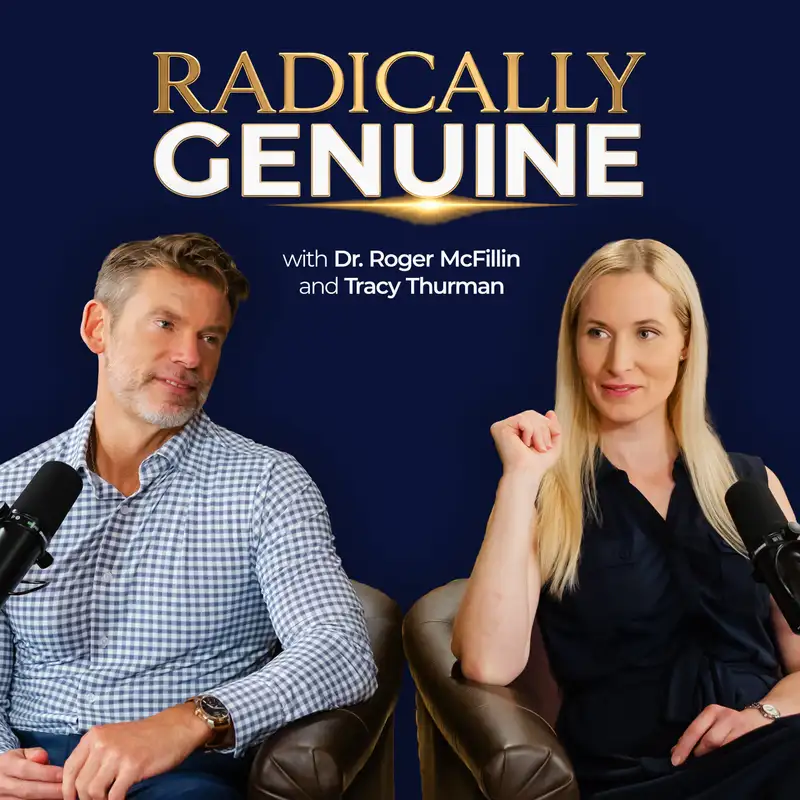
217. The Harms of SSRI's During Pregnancy Debate w/ Dr. Adam Urato and Dr. Robert Chen
Dr. McFillin (00:03.069)
Welcome to the radically genuine podcast. I'm Dr. Roger McFillin. We gather today to examine one of the most consequential yet under discussed topics in maternal health. The use of selective serotonin re-uptake inhibitors during pregnancy and the postpartum period. The scope of this issue is substantial. The use of SSRIs for women of childbearing years has skyrocketed post 2020 with some figures suggesting
one in five females of childbearing years are on an SSRI. It estimates that approximately eight to 10 % of pregnant women in the US take an antidepressant at some point during pregnancy, which may actually be an underestimate. What makes this discussion necessary is a fundamental tension. We have women reporting low mood in our medical centers based on symptom checklists.
Yet the primary pharmacological intervention they've relied upon for three decades does raise serious scientific questions about both efficacy and safety for the developing fetus. Informed consent is rarely, if ever, provided because practicing physicians are not well informed on this subject. The FDA recently convened an expert panel on this very topic bringing together perinatal
epidemiologists, developmental biologists, maternal fetal medicine specialists, psychiatrists and psychologists. What emerged was not a simple consensus, but rather a clarification of what we actually know, what we don't know, and where our current practices may be outpacing our evidence. Three foundational facts are not in scientific dispute. Serotonin plays a crucial role in fetal development.
SSRIs disrupt the serotonin system and SSRIs freely cross the placenta. The implications of these three facts for fetal development deserve rigorous examination. Recently, there was an interesting exchange on X where one of the most outspoken and key thought leaders on this subject is Dr. Adam Urata. This is his third appearance on the Radically Genuine Podcast.
Dr. McFillin (02:22.367)
He's a maternal fetal medicine physician in Framingham, Massachusetts. He's an expert witness in antidepressant litigation and writes and lectures regularly on antidepressant use during pregnancy. He attended Harvard, Harvard Medical School, completed his OBGYN residency at Massachusetts General Hospital and bring him in Women's Hospital. He completed his maternal fetal medicine fellowship at Tufts Medical Center.
Dr. Urato has an active clinical practice and he takes care of high risk pregnancies and delivering babies. He was recently an expert panelist on the FDA panel hearing on SSRIs during pregnancy, which reviewed these risks on fetal development. Dr. Urato has opened himself up to criticism from mainstream psychiatry. They're often critical of his conclusions and often support pregnant mothers on staying on the drug and state publicly that there's no known risk to the fetus.
and instead discussed the risk of clinical depression, both during pregnancy and postpartum. It was often suggesting that the drug actually prevents this condition. What occurred recently on X was an original poster who refused to enter into the debate on this subject was challenging many of Dr. Urato's claims. Instead, Dr. Robert Chen jumped in willing to enter into the debate and he is a third year psychiatry resident at the University of Washington. He did his MD, PhD,
at Washington University in St. Louis studying the effects of the gut microbiome on childhood growth and development. His current research focused on novel biomarkers and therapeutic development for serious mental illness with side effects into or side quests into how AI will impact psychiatry. What makes him a fascinating guest is that he's young in his career. He's still a resident.
He's being exposed to the standard care and treatment of psychiatry, but he also appears to be a scientist at heart and values the scientific process and the search for truth. So he's going to be an interesting addition to this podcast because we're seeking truth. So I'm very grateful for him choosing to come on the show. The goal here is to allow both physicians ample time to communicate their positions. I, as a moderator, will be heavily focused on asking the questions
Dr. McFillin (04:40.693)
The public wants answered. Myself as a psychologist get these same questions. There will be follow up directed at both doctors and ample time for rebuttal. This allows for a flexible approach without specific time limitations or restrictions on their ability to communicate. We want these questions to be answered and I take my role seriously in asking the critical questions on this very subject. I want to welcome
both Dr. Chen and Adam Urato to the radically genuine podcast.
Robert Chen (05:14.989)
Yeah, absolutely. I'm really looking forward to it. It seems like it's going to be fun and my goal is to learn something and hopefully teach something. If there's anything of value I can add.
Adam Urato (05:15.343)
Great to be here, Roger. Thanks for hosting this and Rob, thanks for agreeing to do this. I appreciate it.
Dr. McFillin (05:31.434)
That's the purpose of the show. This is show that really does value informed consent. And what I wanna do is allow both of you gentlemen the opportunity for just an opening statement. And I think that what's most important right now is for you to speak to the challenges that physicians are facing when advising pregnant women, or women who are intending to get pregnant, who are currently on SSRIs. So we're interested in understanding the current risks
and benefits of the drug. And if it's possible, while one person is speaking, can the other one mute their microphone? Okay. And we're gonna start with Dr. Urato. Dr. Urato is a well-known expert in this area. Of course, he's been on the FDA panel discussion around this very subject and speaks openly on podcasts, is a well-known expert in this field. Dr. Urato, if you can please just start with an opening statement and address those initial questions.
Adam Urato (06:30.469)
Sure. Well, first off, thanks again for doing this. A couple of points of clarification. Part of this got started with an exchange on Twitter. The other physician had called me a grifter during that exchange. I just wanted to point out that I don't have any conflicts of interest. My disclosure is, Roger mentioned in the intro that I had done some expert witness work. This was about 10 years ago.
don't do anything, I haven't done anything subsequently. I don't have any disclosures, no conflicts of interest in this. And the second point I'd like to lead with is that when we talk about this subject, I always try to make sure that people understand that I'm a community physician, I'm taking care of patients in my community every day, and I'm often taking care of and counseling patients with depression, patients who are on antidepressants. And so the goal here isn't,
to pill shame anyone or to beat them up for being on medication. Depression can be a severe condition to go through, suffer through. Human suffering is awful. And so this, my discussion about the medications is in no way geared towards trying to make anybody feel ashamed of the way they're managing their mental health. It's more just to make sure that patients have the right information so that they can actually give informed consent.
The big frustration for me, the big thing that motivates me is that I think patients and the public aren't getting the right information. I don't want to accuse anyone, but they're being lied to essentially. They're not getting the right information about these medications. And that's coming in two forms. One is the risks. Roger led with the fact that
We know serotonin plays a crucial role in fetal development in pregnancy. We know that the SSRIs disrupt the serotonin system and that they cross the placenta. It just stands to reason that they're going to have an impact and alter pregnancy and fetal development. And that's in fact what we see when we do the animal studies and then when we do the human studies. This has been shown again and again in the literature. And what's emerged are these risks like
Adam Urato (08:48.303)
birth defects, miscarriage, preterm birth, low birth weight, preeclampsia, postpartum hemorrhage, and then newborn issues and issues beyond that. As these children grow up into teenage and adulthood, issues like learning and speech difficulties, depression, mood disorders, and things like autism and ADHD. So we've got a substantial body of evidence on that, which we can discuss today. But these risks are there, but
pregnant women and the public aren't being warned about them. If you look at the label, the only warning that we're seeing there on the label is for newborn issues, postpartum hemorrhage, persistent pulmonary hypertension of the newborn, which is a newborn issue. So very little on the other things and really no information about disruption of fetal brain development and the long-term impacts of that. So that's one frustration of mine that motivates me to try to get the right information out. The second major issue is that
pregnant women and the public are being told what essentially represents a sales pitch. And what that sales pitch is, is that the drugs are completely safe, that they basically don't have risk. And in fact, that was a recent editorial in the New England Journal of Medicine basically stated that they may have no risk in pregnancy. And patients are being told that by taking these drugs and by controlling their mood during pregnancy,
they're able to get better pregnancy outcomes. And this sounds good. And you could see that if you were a marketer or working for pharma, it would be a great sales pitch to try to sell the drugs. But when we actually do the studies, that's not what we're seeing. We're not seeing that the group of women on SSRIs who continue their medications is having better pregnancy outcomes. In fact, in dataset after dataset, study after study, wherever you look,
whether it's San Francisco, whether it's Kaiser, whether it's Massachusetts, whether it's Denmark or Sweden, what you find is that the group of women on the medications are having worse pregnancy outcomes, they're having more preterm birth, and their children are having more issues. Now those will sometimes get corrected, which we'll talk about, adjustment, et cetera.
Adam Urato (11:08.474)
But this is what motivates me is that pregnant women and the public aren't getting the right information on these things and they need to in order to make this very important decision. I'm gonna wrap up here. I know I've been rambling, but I always say never before in human history have we altered pregnancy and fetal development in this way. And so we really need to make sure that we're getting the right information out on these drugs. And so that's sort of what motivates me and what has pushed me to try to get the word out on.
Dr. McFillin (11:40.576)
Thank you, Dr. Chen.
Robert Chen (11:42.286)
Very well said. Yeah, it does seem like we're in this phase of society where mental health disorders are rapidly on the rise. There could be many ideological reasons for that, some constructed and some not. The prescription medications to treat these disorders are also rapidly on the rise. And we may not know what the outcomes of that will look like until...
10, 15 years down the line. So I do think it's important to try and be as cautious as we can to be evidence-based and to understand the limitations of what we know we don't know. So I think, you know, from those places of sentiment, I would just say that I certainly agree. I just have a couple of disclaimers. I'm a...
Psychiatry resident. And so what that means is that I'm still in training. I am not an expert in psychiatry, nor am I an expert in perinatal psychiatry. So that is disclaimer number one. Disclaimer number two is that these, anything that I say in this podcast, these are my opinions based off of research I've done and don't reflect any of the organizations that I work with. That includes University of Washington, as well as the APA for which I'm a member.
And then the third thing I'll just say is that a big part of why I'm interested in being here is to talk about scientific communication and informed consent, what that means and how to look at the literature. And so from that lens, I would just like to say that.
Many of the things that Adam is talking about, I believe are true. Those three undisputable facts, I also think I agree with. Serotonin is an important neurotransmitter. We know that it's important in fetal development. We do know that SSRIs cross the placenta and so have access to the fetal brain and the developing brain. I think there are three things that, you know, where I look at the evidence, I have a question mark about. The first is if there was a consistent effect,
Robert Chen (13:35.526)
of SSRIs and serotonin on the fetus, I would imagine that when we look at these neurodevelopmental studies, we would see similar effects on the brain in different cohorts that are irrespective of geography. And what's surprising to me is that we don't see that. The neurodevelopmental effects are usually pretty variable across studies. That could be a sample size question. It could be a question of maybe we just need to...
see more studies, I think it's unclear. And what that raises the question about is what is the actual clinical impact of alterations that we see? In some studies, you will see an increase in brain size, and others you will see a decrease in brain size. And how those relate to symptoms is still really unclear. And whether that leads to development of mental health disorders down the line, or actually adverse outcomes, I think is also unclear. That's not to say that there are no, I would definitely...
say that we don't know for sure there are no adverse outcomes. So I think that anybody who saying that, I would put a question mark there. But I do think it's important to ask if there are changes on brain chemistry and brain development, are those changes consistent and do they have a clinical impact down the road? The second thing is what Adam referred to of many of the studies that we have in pregnancy. They are really difficult to run in an ethical way and what we would consider, you know,
I'll just put loosely in quotes, gold standard randomized controlled trials. Instead, we rely on cohort studies because ethically it can sometimes be difficult to run randomized controlled trials at scale in pregnant women. And based off these cohort studies, ascribing causality is really difficult. There are ways to try and ascribe causality by controlling for a number of different variables, and we can get into that. But once you do control for these variables, what you end up finding is that there are
It's not that there are no risks. think I have high confidence that there are at least two things that SSRIs contribute to worse outcomes based off of the literature that I read. But many of the other adverse outcomes can be attributed to underlying depression or depression severity. But the two outcomes that I think that should be counted on universally are low Apgar scores at birth. I think that is a consistent risk increase with SSRIs as well as potentially for preterm birth.
Robert Chen (15:58.412)
So that's the second point that I think I would just say is that confounding is a really important and critical piece to understand in reading the literature. I think the last thing I would just say is that my take on this is that communication about these risks is really what I'm most concerned about. The communication piece, when I looked back at the ACOG guidelines that they put out on SSRIs in pregnancy or maternal depression, they actually
put in a lot of studies about these risks and they talk about them. And what ends up not being reflected is in the conversations between patients and providers or the discussions on social media. And so I think trying to address why is it that these professional societies do these really deep literature reviews, really provide really high quality evidence, and then ultimately somewhere down the line that gets lost in the communication between patients and providers leading to informed consent that is, I think Roger put it, is really not informed consent.
That's like a big area where I'm really frustrated with as well. those are kind of the that's kind of the angle that I'm coming in with. And I think probably where we'll have the richest discussion is about what the studies in humans say about confounding and what the actual risks are once we adjust for those things.
Dr. McFillin (17:15.179)
Thank you. Gentlemen, the question I get most frequently, because what happens in these medical settings are the physicians are advising pregnant women against the potential risks of not being on the drug as far as an experience of clinical depression. So the question is regarding efficacy, and I want to refer back to the SSRI panel discussion.
Dr. Berard stated directly, there's no randomized controlled trial in pregnancy showing efficacy, showing any benefit. Dr. Joanna Moncrief presented data showing the difference between antidepressant and placebo in general trials is essentially clinically meaningless, approximately two points on a 52 point scale. She characterized it as absolutely minuscule.
Dr. Healy noted that the only SSRI trials were conducted in primary care settings, not hospital settings. They don't seem to help with severely depressed patients. While there was a counterargument, Dr. Roussus Ross argued that observational data from hundreds of thousands of patients across multiple countries provides robust evidence. So basically saying, you know,
observing the response by their patients is what's informing clinical decision making. Yet the problem is we see high placebo response rates that I think interfere with us, our ability to be able to come to that conclusion. So my question is, first and foremost, why would it, why would any pregnant woman be on an SSRI or any woman who was intending to be pregnant be on an SSRI at all? And I want to start with Dr. Chen.
Robert Chen (19:04.664)
Yeah, so, you know, I think one thing that can be really challenging with trying to answer this question is that, again, there's sort of an ethical concern about running randomized controlled trials in pregnant mothers. So the absence of evidence does not necessarily mean evidence of absence, but it is true that it's harder to draw causality. And that goes both ways, showing the efficacy of antidepressants as well as showing the harms of antidepressants. So that's kind of the first thing. So in absence of that, what
What are we supposed to do as clinicians who still have to condense literature that can be conflicting into a binary decision or an informed consent process that leads to a decision for a patient to help provide care for their family? One area is we just look for the highest quality evidence that we can. In cohort studies, what that means is looking for large sample sizes, looking for controlling for something that's called a propensity score, and essentially trying to match patients between different groups on multiple characteristics that could affect the
exposure and then the result of the exposure. And then the last thing is trying to do careful other side experiments that control for confounding of genetics and environment. And so that's kind of one area where we try to look for evidence. Another area we try to look for evidence is to borrow information from not exactly the same patient population, but maybe a comparable patient population. So maybe we're thinking about adults, women who are in childbearing age who are not pregnant and seeing how they do.
with SSRIs and treating depression. And so we try to borrow information from there. So what do we actually know about SSRIs and untreated depression, and then how well SSRIs do with treating depression in pregnant women? From what I can tell, the evidence is strongest for the following two things. Number one, the evidence is quite strong that stopping an antidepressant can increase the risk of relapse. And that risk of relapse
can be reversed, meaning that the precip episode can be treated by reinstating the antidepressant. This is shown in two different trials. Now we can talk a bit more about the details of them. And again, think people should, I encourage people to fact check me about these things because I don't remember all the details of the trials, but I think it's really important that when we live in a world where evidence and AI is used by nearly everybody who has access to it, there is no point in trying to hide behind.
Robert Chen (21:30.444)
You know what I say on on air people can look this up. And so I think it's important that people do that But the the two trials I'm thinking of one was published I believe in JAMA in the early 2000s and was looking at relapse risk of mothers who were often antidepressant The relapse risk was about five-fold compared to people who? Ended up continuing and then in a different study. It was kind of an interesting design
They looked at mothers who discontinued the antidepressant by themselves without letting the physician know. They looked at mothers who ended up consulting with their primary team to discontinue the antidepressant and then looked at that compared to continuation. And in both of the groups, regardless of the reason for discontinuation, the risk of relapse into a depressive episode was estimated to be around eight times higher than when you continued and then reintroducing the antidepressant medication.
brought people out of the depressive episode. And this risk specifically was driven by women who had never had a pregnancy before. So that risk wasn't there for mothers who had one or more pregnancies prior. And so that's kind of risk number one is the risk of relapsing into a depressive episode. There are other risks that are drawn from cohort studies, but the reality is that ascribing causality is pretty difficult. When you look at cohort studies,
there seems to be not really an increased risk of psychiatric emergencies, would be a very, consider a very serious outcome from discontinuation. And so that's something that we'd be looking for. Like, can you actually prevent hospitalization or psychiatric decompensation that is serious enough to be admitted to a psych emergency department or a hospital? All of these studies and the conclusions of these studies, the authors always note that one thing that's really difficult to ascertain from these cohort studies is whether there's confounding by severity of depression.
Typically in these cohort studies, the people who end up continuing on their antidepressant are usually the ones, at least this is what's sort of estimated, are the ones who typically have more severe depression. And so you can imagine when they have a discussion with their psychiatrist or their perinatal team that there's maybe less comfort with discontinuing. And so ultimately they end up staying on and they end up potentially having worse outcomes. The flip side to that is it likely means that SSRIs, even in this very severe population, may not actually have the impact that we would want.
Robert Chen (23:52.941)
What we don't know is whether those same women without the antidepressant would do much worse. And so I think that's the unopened question. So maybe just to summarize, would just say that there's a risk for relapse. Esthetics do seem to prevent the relapse risk. For more serious psychiatric emergencies, it's kind of less clear. And there's also some mixed evidence on postpartum depression, but a large portion of the literature suggests that untreated antenatal depression is a much higher risk factor for post...
part of depression as well, but I think the evidence on whether SSRIs actually are effective there is kind of less clear to me.
Dr. McFillin (24:28.813)
Dr. Urata, this is very interesting because I think this was some of the counterpoints on the SSRI panel discussion regarding relapse. Can you speak to that?
Adam Urato (24:39.822)
Yeah, Rob, I think you made a whole bunch of good points both in your opening statement and then in just what you said now. I've been writing scriveling down notes here. You made a lot of very good points. I think that there's two separate questions and one is non-pregnant patients and the other is pregnant patients. Those are two separate issues. So Roger was touching on the information or the studies in non-pregnant women.
And that's what Joanna Moncrief talks about a lot and the fact that in the randomized controlled trials, we actually see very little benefit. Joanna says that it's two on a 52 point Hamilton scale. And so that the evidence isn't strong there in non-pregnant populations. That's one you guys can discuss. I typically focus on pregnancy. In pregnancy, we don't have randomized controlled trials.
So we're just looking at how moms do. The major problem with trying to figure out how effective the drugs are by looking at women that come off of them is the issue of withdrawal versus relapse. And that is a huge problem in trying to figure out these studies. So the first paper you mentioned, Rob, is the one that everyone quotes the Cohen et al. 2006 paper in JAMA.
And that showed this very significant increased risk of what they called relapse of depression in their population. The problem is that they didn't mention the word withdrawal once in the manuscript. It doesn't show up anywhere. It's not even acknowledged as to whether these women could be having withdrawal. Now, to give them the benefit of the doubt, it was 2006. And I think we've learned subsequently more information about how
how many patients have difficulty with withdrawal from these drugs. That paper also became well known because none of the authors disclosed that they were being funded and tied, they had ties to the pharmaceutical industry. And that was pointed out to JAM and became its own sort of story there about the problems with conflict of interest in medicine and how many of the leading researchers in this area
Adam Urato (27:01.71)
have ties to pharma. And certainly the conclusion that they reached, you could see as being very pharma friendly. Basically don't come off your medications during pregnancy because you'll have this very high rate of relapse of depression. So I think we don't necessarily know if it's relapse versus withdrawal and that hasn't been teased out. But I'm very cognizant of this when I talk to patients and that's what makes it
challenging to counsel regarding this during pregnancy versus non-pregnant. During pregnancy, you're weighing risks, benefits, and alternatives of the medication. And the risk in this case of coming off can be relapse. You could also say, well, it can also be recurrence of depression. But you've got to factor that in. That's why I always try to make the point that this information that I'm trying to get out
information regarding risks, information regarding what I see as a lack of improvement in pregnancy outcomes. This information is information that really needs to get out to the general public and to women of childbearing age, because it's something I think that should be factored in to a woman's decision, even when she's starting the medication, because by the time she's in pregnancy, the weighing of risks is different, because now you've got the issue of if I come off,
What's gonna happen? Am I going to be dealing with withdrawal during the pregnancy? So I think that that really factors in. As far as how, what happens when women come off, about half of women come off these medications during pregnancy. And I see this every day in the office. I'm taking care of, I take care of patients. I'm a clinician, I'm taking care of patients all day. And I see it in the office. Some of them do well, they do fine. They appear to not have had much withdrawal. Other ones,
don't do as well, they do poorly. Some of them resume their medication. But when we look at the studies, it's roughly half of women stop their medication, stop their SSRIs when they get pregnant. What you said, Rob, about the severity is a very good point and people think that may reflect a difference. Dr. Yonkers, Kim Yonkers is a famous researcher and physician psychiatrist in this area. She had a paper a few years after the 2006 Cohen paper.
Adam Urato (29:24.144)
that did not show this relapse of depression. I believe she was one of the co-authors on the Cohen paper. She said it wasn't there. They really didn't find a significant increased depression risk in their population of women who stopped. And she thought it might've been due to the fact that her population that she was studying, I believe it was at Yale, was less severely depressed than the Cohen population from 2006. So it may have something to do with that severity.
What I think though is a key component that's missing here is that what we're being told is that untreated, something doesn't work with what the sort of, I'm gonna call it the pharmaceutical sales pitches. The sales pitches that untreated depression carries significant risks and that the SSRIs themselves are basically without risk or close to no risk.
and that they improve maternal mood. So if those things were true, what we're being told by the pharmaceutical industry or this story we're being told about the drugs, that they're highly effective for depression and that they really don't cause harms and that depression itself is very likely to cause pregnancy harms like preterm birth, et cetera. If those things were all true, then when we do the continuation versus the continuers versus discontinuous studies,
we should see that the discontinuers are having complications and doing poorly. So if the drugs are effective and they're safe, they don't have risks, and if depression represents a significant threat to the pregnancy for preterm birth, et cetera, the group that stops the discontinuers should have high rates of those complications because they should be having recurrence of depression.
and that should be leading to increased preterm birth, increased low birth weight, et cetera. But that's not what we see. In data set after data set, it's the continuers that have increased rates of pregnancy complications. So I'll wrap up. I've been talking, but if you look at these studies and there are multiple of them, sort of three group studies, you've got the continuers of SSRIs, you've got the discontinuers, and then you've got a control group. And the question is something like,
Adam Urato (31:44.231)
which group has a higher rate of preterm birth. What you see is that the continuers have a rate of preterm birth of like 14, 18, 20%. The discontinuers have a rate that's more like 5%. And that's also the rate that we see in the controls. So what it looks like is that something is wrong with that model about depression and how effective the antidepressants are and how that prevents complications. What the studies look more like is
And when I started my career, when I was a fellow, I actually studied smoking in pregnancy. And what the SSRI data looks like is more like the smoking in pregnancy data, which is that the discontinuers have basically less fewer complications, less preterm birth, but it's the women that continue that have the complications. So it really looks like a chemical insult, a chemical harm.
Dr. McFillin (32:40.101)
Thank you. I'm going to ask a direct question to Dr. Chen, because I think this Cohen paper is really important. I'm glad you brought it up because it does bring up the concerns. What I see as a practicing clinician is an epidemic of prescribed harm where people getting off their SSRIs are being tapered off the drug way too quickly initiating withdrawal and that being re-characterized as a relapse back into depression.
We have learned a lot more since 2006, but what we've learned has not been integrated into standard psychiatry, meaning that psychiatrists, our most practicing psychiatrists in corporate medicine that I interface with daily have never even heard of hyperbolic tapering. Instead, they're following old protocols. So I just want to get your thoughts, Dr. Chen, on how that is part of the training currently for psychiatrists on being able to safely discontinue the drug.
Robert Chen (33:38.188)
Yeah, I think that's such a great point and Adam, think many of your points are very thoughtful and I can circle back to just one of them to address later. just to, Roger, just to answer your question, psychiatry is changing. At least that's how I feel in my program and some of the trainees that I've interfaced with at the APA conferences. get together, we got together last year with many of the fellows from across the country. And what I see is that this is becoming recognized
nice. Hyperbolic tapering is now standard of what we're taught.
We're taught about receptor occupancy. It's taught in standard in part of our training now. I think part of that though is that we're part of a large academic institute, a research institute. And I don't know how reflective that is honestly across the United States. I just want to acknowledge that I'm very biased because I'm in this training environment. What I hear from a lot of people on XM is that it's not widely practiced, especially when general practitioners or primary care family medicine docs are the
ones who are likely prescribing the most antidepressants in the United States. So I don't know if that has percolated. I do believe that hyperbolic tapering at least was instituted as part of the most recent recommendations in the family medicine kind of group. And so I think that that's also getting more widespread acknowledgement. So I don't know if it's going to be implemented more widely. We may not see the effects until...
five, 10 years as this cohort gets into practice or this generation of psychiatrist trainees go into practice. But I will just say hopefully reassuringly that it is now being taught as part of standard of care.
Dr. McFillin (35:17.231)
That's good to hear. So another question that we get frequently, and I did seek out some audience questions for today, was this concept of untreated depression. This was also brought up on the SSRI panel, and untreated means not being on a drug. And so my question, and I want to start with Dr. Chen, is why do people get depressed? And then what would constitute effective evidence-based treatment?
Robert Chen (35:47.37)
If I knew why people got depressed, I would probably win a Nobel Prize. I think the reasons for depression are multimodal. Maybe a broader question is how do we ascribe causality in mental health disorders when we have no objective biomarkers beyond symptom report and clinician judgment.
One way to start is we look at other fields that didn't have biomarkers and learn from them. In many fields, we started with the most severe cases because the most severe cases end up enriching for a genetic or biological underpinning.
We look at what happens, can ascribe causality there, and then we see if that has a broader range across other psychiatric disorders. Depression is really tricky. We don't really have good genetic evidence that there is one underlying cause. And across psychiatric disorders, even for disorders that we do have pretty good understanding of the genetics, it's spread across hundreds of thousands of genes. And so there really isn't one single smoking gun here.
I guess I would just say that I think untreated depression should encompass far, far more than not pharmacologically treated depression.
In fact, the ACOG guidelines recommend that psychotherapy can be considered as a first line treatment for perinatal or antenatal depression. And I think that's totally reasonable. In fact, in my practice, oftentimes I just use shared decision making. We go through informed consent and 80 % of the time people don't even want to start a medication. And in my clinical judgment, when I think that that's acceptable, I let them know like, hey, let's try that and see how it goes. Knowing that we can always talk about medications again at a future time if things aren't working. So I think that's a misnomer.
Robert Chen (37:27.757)
I certainly hope that's not standard practice across the nation or more globally. I think there are many other options for treatment for depression, especially if it's in the mild depression and moderate depression. think most guidelines recommend starting pharmacological treatment in conjunction with CVT. And then for severe depression, that's kind of a whole nother different take where pharmacology is almost always indicated.
Dr. McFillin (37:49.809)
Dr. Chen, are you concerned with how depression has been characterized by your field and the use of the DSM? We're assuming here that there is actually this medical-based condition called depression, but really all it is is symptoms that were used for communication purposes and to interface with the insurance companies. we talk like there's this identifiable discrete condition and it's called depression, but really when you...
reduce it to two weeks of somebody feeling, experiencing low mood, it just seems to be a human problem.
Robert Chen (38:26.813)
Yeah, it's a this is one of those very age old questions in psychiatric nosology that's we've been embattled with ourselves for, you know, the past hundred years. I have mixed feelings about the DSM five and psychiatric nosology in general. And when I say nosology, all I really mean is how do we define a disease? The DSM five was the field's best effort, however flawed it was to be able to come up with a way to find individuals who had functional impairment due to
something related to their mental health that you can enrich for a group of people who had similar patient characteristics, who had similar treatment responses, who had episodic versus continuous nature. And at its very core is an enrichment mechanism. It tries to find people who are similar in some way, shape, form. I'm not sure if it was just for insurance claims. I do think they were trying to find people who might have better response to a treatment versus another. And I think that for many things that they succeeded in some things, I think that they were less successful.
maybe just because of the nature of the heterogeneity. So, I think if any of your audience members are interested reading through the DSM field trials, there were two major papers, one of them was by Rizhir's et al, looked at how well or not well different diagnoses in the DSM-5 had reliability. And it turns out depression had pretty poor reliability, meaning that two patients could be looked at by two, a patient could be looked at by two different clinicians and,
30 % of the time, they would actually disagree about the diagnosis, and that's pretty high. But for the vast majority of psychiatric diagnoses, the test-free test reliability is quite good on par with other aspects of medicine. But I would say that affective disorders, specifically depression and anxiety, are not as great as we would hope. What do I feel about that? There is a tension between access to mental health care
and overdiagnosis. And a big part of this is a pair of socialism that can happen when we start to see a lot of content or see a lot of relatable people who are describing their symptoms as in line with what we would consider depression or anxiety. And I have mixed feelings about it. I think on one hand, I do want people to have access to mental health care. And on the other hand, I think that a lot of people who are really worried that they might be suffering from depression or anxiety may be experiencing kind of what you said, which is
Robert Chen (40:47.969)
a normal stress response that has been pathologized. The only way to really know is to work with a trained professional. What I'm not sure about is how good that training is outside of an academic research institute. In fact, even in our own institute, I still think that there are challenging diagnoses to make confidently. So anyway, that's just a little bit of humility that I'd like to put out there that the field is pretty imperfect and the field is just trying its best.
Dr. McFillin (41:14.236)
Before I get to Dr. Otto, just a quick question. Do you understand about Kappa scores? Maybe you can inform us because you are a researcher. When the DSM field trials used a Kappa score statistic for iterator reliability, where 1.0 equals perfect agreement and 0 would be chance agreement, when there is a Kappa score of like 0.28, what does that mean?
Robert Chen (41:43.692)
I don't want to overcomment on the statistics without reviewing it. It's been a bit since I've read the paper. I do remember the COHINS, the CAPA scores are pretty low, like they're less than 0.3 for anxiety and depression. What I remember when I was reading the paper was that that does not mean that only 30 % of the time two people agreed. There's actually, that doesn't translate directly to probabilities. So maybe in the show notes we can get back to it, but it's quite a bit higher than just saying that two physicians agreed only 30 % of the time.
Dr. McFillin (42:13.148)
Yeah, well, it was previously considered unacceptable. So it wouldn't even been a condition allowed to be in the DSM. what they did was rather than improve the criteria, they just simply lowered the bar for what constitutes as acceptable and they redefined Kappa values as 0.2 to 0.4 as acceptable when the field had historically considered anything below 0.4 as poor.
and below 0.6 as questionable. The reason I say this is because even psychiatrists can't agree on what is depression. So of course, when I ask you this question about why people get depressed from your training model, it's gonna be very, very difficult. But from my opinion, the reason people get depressed is variable because the human experience is variable. And all you have to do is ask people about their lives and they tend to tell you very clearly, but that's not what happens in our medical systems. And it leads to...
these type of discussions where we say, it's a biomedical problem, here's a pill. Dr. Iurado, I want to kind of get a sense you do interface with patients every single day. Why do people get depressed?
Adam Urato (43:21.626)
You're asking a great question. I think that it's complicated. agree. But my leaning towards this from listening to my patients over the years is that it is a reasonable response to life circumstances. What's happening is sort of a reasonable human response to life circumstances. And I'm probably influenced in that thinking by reading a lot of Joanna Moncrie's work. And I'd be curious, Rob can tell us whether or not people are thinking along her lines in the training program.
But from listening to my patients, what's going on with them, it's often things like, maybe number one on the list, relationship difficulties and challenges, relationship struggles, and then would be work or finances, how their kids are doing, problems with their kids. These are the things that seem to be prompting the depression in my patients or mental suffering, however you'd phrase it.
Is it more complicated than that? Do some people have stronger reactions? Sure. And I think the one thing that I've realized in taking care of patients for all these years, for decades, also in researching this area is how complex the human brain is and our responses to things and how everybody, everyone is different. But me looking at it and listening to patients, it's often something going on. What's going on in your life?
And it's often a reasonable, it seems to me that they're suffering to some extent as a reasonable response to those life circumstances.
Robert Chen (44:58.539)
you
Dr. McFillin (44:58.555)
Yeah, I mean, it's interesting to review at this point, because just, I think there's some degree of agreement. One, don't really know why people get depressed. I mean, from the medical professional's perspective, I mean, it's not generally your role to even answer that question. And the way that we have evolved the medical system in the United States is these appointment times are shrinking, even for psychiatrists, because of the financial incentives.
we don't have really strong robust evidence that we have an anti-depressant drug. That's a marketing term. So we have an SSRI, it has consequences, but it's very difficult for us to come to clinical conclusions that we have this medical intervention for what may be a very human problem. We know we've increased the prevalence rate of depression by just developing criteria that
creates more and more normal human reactions into a pathological lens. And then of course, the financial incentives from the pharmaceutical companies and in corporate medicine and interfacing with insurance companies is we're seeing more and more of these drugs prescribed. And so the question most people have is like, if I'm struggling, do I require that drug? And because the medical professionals are saying, yes, you need this drug, it's a standard of care and
Right now, I think we can say there's questionable efficacy at the very least at all for the use of the drug and we're not even conceptualizing the problem to a very accurate degree, which brings up the informed consent issue, which you're going to get to. But again, what happens when these patients come into Dr. Urata's office is many of them are on the drug already. And so I want to be able to really speak more specifically about
these potential risks. During your opening Dr. Urato, one of the things that has frustrated you is the disruption of fetal brain development as what you believe to be a known risk. I'm hoping maybe you can discuss this further and from what your research has been, what leads you to the conclusion that we have these known risks knowing that there haven't been any RCTs?
Dr. McFillin (47:15.454)
with pregnant women on SSRIs.
Adam Urato (47:19.386)
Yeah, so when we look at the studies sort of
I usually start off and try to walk people through this, that there's common sense. The common sense is if serotonin plays a crucial role in brain development and you're disrupting it with an SSRI, that you'll disrupt brain development. So that's sort of the common sense. Then you move to the basic science studies. When you look at some of the basic science studies, like do the drugs affect neurons? It looks like the drugs do have an impact on neurons, which would just make sense. It's common sense that they're going to have an effect on neurons. mean, the serotonin transporters
plays an important role. We think these are blocking that transporter among other effects. And the same thing in platelets. We know they have a significant effect in platelets. So it's just kind of physiologic. And then when we do these basic science studies on things like neurons or brain organoids, we can see effects or impacts of the drugs. When you move to the animal studies and you look at brain impact, you often find brain impacts on the animal studies.
They can find differences in gene expression, differences in proteins, difference in the structure of the brain. And then when they look after exposure, for example, rats and mice that have been exposed to SSRIs in utero, when they grow up, they often behave differently. They'll have different behavior patterns. For example, they'll have less socialization, what's described as autistic-like behavior, and their sexual function.
can differ. The males who have been exposed in utero to SSRIs will behave differently sexually. So suggesting again that there's something going on, disruption in the brain. Human studies can be more challenging, but we're seeing them now. There are a few ultrasound studies where they do prenatal ultrasound on moms who are taking an SSRI versus controls. And you see that the babies react differently to the
Adam Urato (49:19.387)
moms that are on an SSRI, they have more fetal movements. They call it like an agitated or jittery phenotype that they're moving too much. They're moving abnormally. They don't have enough periods of quiescence. So that looks like, again, that it's having impact on the brain. And then after birth, we find impacts. It's not just withdrawal. We do see withdrawal, but we can see some of these impacts right off the bat, which suggests that it's not just that there's actually ongoing impact.
And now we're doing further follow-up studies, for example, with things like EEGs. There are now three EEG studies and there are 12 MRI studies all showing impact on the brain. So this makes us say, look, this all ties together. Typically what the SSRI advocates say, and this is a really important point here, is they'll default to the human studies. They'll say, yes, I agree with you on...
common sense, basic science and animal studies, but the human effects we see, that's confounding by indication. And that just seems absurd to me when we're seeing the same effects in randomized animal studies as we're seeing in human studies. Now the human studies aren't randomized controlled trials. So you can always default to that. And I don't wanna cast aspersions on my colleagues, but it's somewhat in my mind deceitful. You're trying to fool the public in that sense by doing that.
you can always default to confounding by indication in non-randomized controlled trials. But the problem with that is that when the human studies are showing the same thing that the randomized animal studies are showing, it strongly suggests not that the issue is confounding by indication, confounding by depression, but that it's actually a chemical having a chemical effect. And I would say this on not just the brain findings, but also on issues like
preterm birth, low birth weight and the other complications. The SSRI advocates are always saying that, we can correct those away in the studies by correcting for depression. But that doesn't really make sense. And Rob, I'd like you to comment on this. Why are we correcting away from depression in the group that's on the SSRIs when we're telling that group that this is a highly effective treatment for depression?
Adam Urato (51:42.696)
And we're telling that group that the discontinuers are going to have, that's the untreated depression group supposedly, they should have higher rates of depression. So that doesn't make any sense that we're making these continued corrections. And I'll wrap up with this in the New England Journal of Medicine editorial that just came out. They basically made the argument that we need to ignore the animal studies because animals aren't humans.
And that's really, felt, I really felt that was an awful thing to say for all of the animal researchers who had been doing this research for decades, as well as for all the animals that have been involved in this research and they're exposed to the drug, they're sacrificed. We're doing these to get information about how these chemicals are affecting pregnancy. And they were showing the same thing all the time. What these editorialists in the New England Journal of Medicine went on to say is that what we've discovered over the years
is that we can correct the studies that are there in different ways now to essentially correct out the differences. Yes, we see increased preterm birth in the SSRI group. We see increased miscarriage. We see increased birth defects. We see increased preeclampsia. We see increased postpartum hemorrhage. But with modern epidemiologic statistical techniques, we can now adjust for things and correct those relationships away.
And this really, really bothers me. Mark Twain had a famous quote that there's three kinds of lies, lies, damn lies, and statistics. And I think that falls in here, what we're seeing here, trying to correct away the actual finding that these chemicals are having a chemical impact and tell people, which is what this New England Journal of Medicine editorial told people, is that they don't appear to have any risks at all. That just doesn't make any sense.
Dr. McFillin (53:37.277)
Dr. Chen.
Robert Chen (53:38.759)
Yeah, a lot of ground to cover. Okay, so maybe we can follow a similar track with preclinical studies and then maybe go into the clinical studies. I think on the preclinical studies, this is basically not in humans. And so we look at cells and we can look at animals. And I think that they have value. I think we should be looking at these studies and say, hey, they allow us to have mechanism. We can control for things very tightly. We can knock
a receptor out, we can control for really, really in detail causality. And that's one of the advantages of them.
Where it's a bit tricky is when these causal studies are showing opposite things. One study might show that there's increased endorheic growth. Another study might show that there's decreased endorheic growth. One study might show neurotoxicity. Another might show that there's actually neuron growth. And so I think when we get confusing results, then we try to understand higher up on the evidence hierarchy something that is more translatable toward humans. So maybe that's just point.
one thing I think about when I think about reading the literature. The second thing is in animal studies, that's a lot closer to humans. I don't think we should ignore them. I think we should weight them appropriately as far as what they can tell us about physiology and these drugs. Again, you can do really, really important control studies where you can expose...
We can expose dams, that's kind of the word for a pregnant mouse, to medication. You can control the timing of it and then you can look at the fetus, especially you can look at long-term impacts of the fetus. And so I think those are invaluable studies. Again, when you start finding conflicting results about these studies is where I start to say, okay, some studies are showing more.
Robert Chen (55:22.876)
autistic-like behavior in the mice. Some are showing that they actually have less fear response or are braver or have less depression when exposed to depression model. So then that's when I start thinking about, why are people weighting these human studies more heavily? And part of it is because there is conflicting results in the preclinical studies. Anyway, that's my take on it. And then hopefully I can talk through this a little bit just to give you an idea of how I think about the literature. On the human side, I guess one thing that I would just say is that my approach to reading these cohort studies is to look for the highest
quality evidence irrespective of the conclusion. And so when I think about highest quality, I think about are they controlling for confounds and are they trying to do control variables or control experiments within the data set that they have to try to ascribe as close to causality as they can. Which again, I think Adam, you make a great point, which is that in cohort studies by definition, you can basically never cause causality. So I think it's really important to come into these studies saying,
I don't care what the outcome is of the study. What I care about is are they doing the high quality research? Because as an example, if you corrected for all of these different variables and you still had the same conclusion, meaning that you did see increased risk for all of these things, I think that would be really high quality evidence saying there are many of these risks and I would still go for that. I wouldn't try to brush that under the rug. I would say that, hey, after doing all of these careful controls, we can see that when you remove shared genetics, remove shared environment, you control for underlying depression, you control
depression severity, you still actually get this effect of SSRIs. You become much more confident in it. And so if that were the result, that's what I would believe in. What the results end up showing is that after you do all of these careful confounds, and like Adam said, study after study have actually done this, there's really only two things that show up consistently in the research that show an increased risk in SSRI-treated mothers compared to either
mothers who weren't on SSRIs trying to control for propensity scores, trying to look at a really interesting study design where the mom actually isn't the one who's getting the SSRI, but the dad is the one that's getting the SSRI. What you end up only seeing that kind of survives all of these different corrections is preterm labor, there's an increased risk by about 20 % and increased admissions to the NICU that's highly correlated with the low APR scores at birth.
Robert Chen (57:45.003)
if it's also increased. And I think that increased risk is a bit higher, it's about 80%, I think from what I had read. But those are the two things I most, I believe the literature the most about. As for the other things, boy, trying to think about is there an increased risk for translating these preclinical studies of increased autism-like behavior.
We don't see that in humans. We just don't see it in the data after doing these careful controls. And so I don't know if there's always a one-way kind of through line between what we see in animal models and then what we see in the human data. But I will just say that some of the neuroimaging studies that you're talking about are quite interesting. I didn't really know much of that literature until kind of doing some reading before the podcast. And I do think there are some pretty interesting neuroimaging studies that do suggest that there are differences in SSRI.
infants that are born and then develop on later in life, looking at brain imaging studies. I think what's challenging is how those actually correspond to symptoms. And also there's a lot of inconsistency with the signal and what parts of the brain regions are increased or decreased. And so it's still kind of unclear how we should weight that evidence. I do think there's probably an impact, but again, how that translates into informed consent, I think is something we can kind of open up as another topic.
Adam Urato (59:00.056)
Can I just have a chance to jump in? I appreciate, your granting the preterm birth and the low APGAR scores, the NICU admissions, along with that, the newborn problems. I think that's right, but I think it extends beyond that. think that several of the authors or many of the authors are making these adjustments and it's still not clear what adjustment is being made for depression itself.
because the studies on depression itself, on how associated it is with complications, they're considered to be of low to moderate quality, and many of them don't show much of a difference just in depression itself. It's not exactly clear how to correct for depression. And furthermore, again, getting back to what I had said earlier, why are you correcting out for depression in the group that's supposed to be treating their depression
and the healthier group. It would be the group we're telling, going into the study, you're saying, going into the study, you're saying, if you come off your antidepressant women, you're gonna have higher rates of depression. That's the group that should have the depression. That's the group where you'd have to make the correction, but we're making a reverse, a correction here. And it's not really clear how that's occurring. When I read through the statistics, a lot of it honestly does seem to be going on somewhat.
I would call it statistical mumbo jumbo to some extent, you don't really have a good way of correcting for depression or of knowing if these women are depressed. A lot of the studies don't do PHQ scores. And those that do often find similar PHQ scores in the groups. When you look at the totality of the evidence, if you just look at the crude data, you see higher rates, for example, of miscarriage or birth defects.
And I'm just gonna go back, Rob, to walk you through this again. Like serotonin plays a crucial role in early embryonic development. So it's affecting the way the embryo forms its organs. It's affecting early pregnancy. The SSRIs come in and they disrupt that serotonin system during that crucial early pregnancy time. So are they gonna have an effect on early pregnancy? Yes. And could that lead to miscarriage and birth defects? Yes.
Adam Urato (01:01:19.932)
Do we see that in the animal studies? Yes. Do we see it in the human studies? Yes. But then what happens? Then the researchers, many of whom themselves are funded by pharma or work at institutions that are funded by pharma, drill into that data set and correct away for depression and for other differences. And there will be differences between the groups because they're not, it's not a randomized control trial.
So you can go back, you can go in and you can essentially over correct or over adjust and then render the difference you see not statistically significant any further. And this has been happening now over decades. And I think honestly, we're coming up with the wrong things to tell. If a pregnant woman asks you in her office, do these drugs, I'm six weeks pregnant. She comes in, she asks you, I'm six weeks pregnant. Does this SSRI, this chemical,
this Zoloft, does it go into the developing embryo? I think the answer you'd give her is yes, it is. Does it impact the serotonin in the developing embryo? You'd say yes. And then you should say, well, how does that not affect like the pregnancy? You'd say it doesn't, the studies don't, they're able to adjust that away. The statisticians have been able to adjust that away. Unfortunately, you can't adjust away the miscarriage.
or the birth defects that she actually is gonna have from exposure to the drug.
Robert Chen (01:02:49.81)
Yeah, I'm happy to chime in on this. yeah, go ahead.
Dr. McFillin (01:02:50.081)
Can I jump in real quick? Because Dr. Levin, who's a developmental biologist at Tufts, explained that serotonin is an ancient signaling molecule affecting neural crest migration, cell division, cytoskeleton function, calcium fluxes, and cellular adhesion. And his research showed that blocking the serotonin transporter caused up to 40 % hetero-taxia.
in embryos, which I think is organ laterality defects. And that was something that was stated clearly on the FDA panel. And this is his area of study. So I'm just considering what someone might be listening to right now. That's pretty concerning. What are your thoughts on that, Dr. Chen?
Robert Chen (01:03:42.443)
Yeah, I'll answer that and then try to go back a little bit to what Adam was talking about. I am not a serotonin expert, nor am I a developmental biologist. So I cannot confidently weigh in on what these effects are. I will just take it at face value that there is a 40 % of these embryos that have heterotaxia. I mean, if that were true, you might expect to see that translate into women who are taking SSRIs, 40 % more of them should have heterotaxia.
associated with the infants, I don't know if there's gonna be a one-to-one translation there. There's probably a lot that happens. Maybe those fetuses don't end up making it. I'm not totally sure. So I'd just be speculating at this point. What I do know is that ultimately when we talk about informed consent, my approach generally speaking is to talk about the mechanistic biology if a patient is interested and then to talk about how that...
mechanistic biology does or does not translate into outcomes for their kid.
And so that's really what we have knowledge about and also just to talk about what we don't have knowledge about like we don't know the reason that you can have serogenergic impacts on a developing fetus and not see these different outcomes adverse outcomes I don't I don't have an explanation for that and that's probably pretty unsatisfying But it's also it's better than trying to make up some reason that I don't fully understand It's just kind of my approach in general
Yeah, so, know, Adam, I think that, you know, I totally agree with you. If you look at the crude analysis, and when I talk about crude, we're just talking about take a group of women who have been exposed to SSRIs and then take all the other women who haven't, and you just look at the difference in different outcomes. I agree with you. The meta-analyses across multiple studies, dozens of studies, all show the same thing, that there's increased risk of different maternal as well as fetal outcomes. I think where we have a little bit of distance is on what statistical adjustment is
Robert Chen (01:05:42.617)
actually doing. I don't view it as mumbo jumbo and I don't view it as kind of like a bad actor trying to find a different outcome. Again, because if you did adjust for these things, you could have also seen that the results would have stayed the same. And if that were the case, you would have really high confidence in what you're finding that all these other things that we know are associated with worse outcomes.
for example, maternal depression. I know up to date may have a tagline about this, but if you actually look at the studies, a lot of the studies are really quite high quality. These are 100,000 plus, million plus sample sizes from entire nations of all people who come in. And so I think we have, if we're gonna try to get the best quality cohort studies, we kind of have access to them. So I think that, at least nowadays, I think some of the studies are quite high quality.
I wouldn't say all of them are, but I just try to focus on the ones that are. I try to draw conclusions from those. It's probably helpful to just explain what the statistical adjustment is actually doing. If you have two things that affect an outcome,
One of them is maternal depression, and then one of them you're asking about is SSRI. You can just look at, do patients who are depressed not on a treatment, do they have different outcomes than women who aren't depressed and nobody's on treatment? And if you find out that there are differences, then what you'd have to ask is, okay, well, there's some contribution from depression on preterm birth, on small for gestational age, on postpartum hemorrhage, on all these other outcomes. We should probably figure out if...
that is the contributor to women who are on SSRIs who are often also suffering from depression or if it's SSRIs themselves. And that's kind of the purpose of the adjustment. And so it's really not trying to inject any kind of smoke and mirrors. It's really just about trying to answer, to get more focused on the question of SSRIs themselves. Otherwise, you'll never know if it's just because of the depression or because of the SSRIs. But Adam, I do just want to say that you're right. Like anybody who wants to be a bad actor here,
Robert Chen (01:07:43.317)
can always point to this cohort study and say, hey, look at that. It's not an RCT, so we can't draw any firm conclusions and shape it toward whatever conclusion that they want. And I think that's really dangerous. I think if people are doing that, then we should be really careful and we should figure out, we should call that out because I don't think that's how we do good science and I also don't think that that's how we can make informed consent conversations happen realistically with families.
Dr. McFillin (01:08:08.982)
Just to jump in here, I don't know how you can identify any research study as high quality if you are unable to reliably agree upon the construct in which you're studying, which was one of the major points I had when I was on the FDA panel when there's not even an agreement on what depression is. Now we have to get into informed consent because this is what people care about. There's the controversy.
of the serotonin hypothesis when it comes to depression. This theory continues to describe, continues to drive prescribing and patient expectations, inflating perceived benefits, minimizing perceived risks. Dr. Lacasse, is a psychologist on the panel, has done some survey research where 88 % of Americans still believe
depression is caused by a chemical imbalance that antidepressants correct. And the framing of this is that SSRIs are normalizing agents rather than psychoactive drugs that alter normal brain function. Now I set both of you gentlemen up for this question earlier by asking you the question, why do people get depressed? Which is a really important question for medical professionals. If somebody comes in with strep throat and you prescribe them
sunscreen, for example, you better be able to explain why sunscreen is going to effectively treat strep throat. But when it comes to depression, it seems like we're all over the place with understanding like what it is and then how people actually get better. Some important points here. This is from Dr. Lacasse's survey. 48 % of women of childbearing age with depression were told by their providers
that the chemical imbalance was an explanation for their problems. 63 % were offered medications. Dr. Moncrief has stated that 80 % of people on antidepressants for two years could not come off them despite trying. And so this is a real concern. Dr. Wood-During described the pharmacy consent process, like patients mindlessly just click yes without understanding what they're even
Dr. McFillin (01:10:32.822)
like agreeing to. Dr. Urato stated on the panel, patients tell him that essentially the only counseling they've received on SSRIs is that they don't affect the baby and they don't cause complications. So women are certainly not receiving adequate informed consent about SSRIs and we have to have this conversation. Let's start with Dr. Urato. You're in this position quite frequently.
how do we talk about this with your patients about why people get depressed? Why would we even prescribe an SSRI at all if we don't have any sound evidence that it's caused by a serotonin deficiency? And I guess in a very short amount of time, like the time that you have with your patients, how do you go over risks and benefits?
Adam Urato (01:11:23.944)
Yeah, this gets to the crux of the issue and the crux of what frustrates me, which is that I think patients are being given, patients and the public have been given the wrong information. And I don't think that they're getting the right information that they need to be able to make an informed choice to truly get informed consent. I think that the pharmaceutical industry rolled out this idea with Prozac in 1987 that it was going to be correcting a serotonin deficiency.
And that through correcting that serotonin deficiency, you'd end up with improved mood. And then when you got pregnant, you look at the pregnancy, you say, well, you have to stay on them. So your mood doesn't go down because if it goes down, you'll end up with more complications, almost guilt tripping the mom into staying on the drug. And then someone could raise the issue and say, yeah, but those groups look, the discontinuation groups look like they're doing better. And then they,
throw up their hands, it doesn't all fall together. But I don't think the story that pharma has rolled out on this over the years really was meant to hold together. It's just a way of increasing sales and profits, whether it's the serotonin deficiency hypothesis, or whether it's the idea of what they're telling us during pregnancy. It doesn't hold up to the actual data. The group that stops doesn't appear to be having worse outcomes, which is what they're telling us. None of that
holds together. When I talk to patients, I try to figure out where they're at and listen to them. And also let them know going into it that that I'm going to support them and do support them in whatever approach they take to their mental health. I'm humble. In general, in the face of my patients, someone's mental health or their mental state is really known only to them. And what's working for them, what has worked, how they've managed it over the years.
That's pretty complex. I feel that my role in seeing them during the time that I have is to try to make sure that they're informed about risks, benefits, and alternatives. The risks I've gone over here, these obstetrical complications and then beyond and then questions later in the development of the baby, the benefit, the primary benefit is the avoidance of withdrawal or avoidance for relapse, depending on how, and we talked about that a little bit earlier.
Adam Urato (01:13:48.733)
And there are alternatives, as you guys were good to point out before, this whole notion that we should be comparing untreated depression with this idea that ignoring pregnant women, ignoring where they're coming from, completely, know, untreating them, not paying attention to them versus a pill, that's not the choice. There's a whole other area in there of listening to the patient, of psychotherapy, of exercise, of improving their diet, meditation, sleep, if they've got relationship problems.
trying to address those, if they've got financial problems, trying to address those. There's lots of other ways than just treated versus untreated. But at the end of the day, I review those things with my patients and then tell them that I support what they do. Only they know how they're doing and where that drug fits in with their life. And it surprises some people when I talk them, but I would say that when I do this counseling, I often do it at 12 weeks when I do the Nucleotranslucency ultrasound or 20 weeks when I do the fetal survey ultrasound.
And the majority of patients decide to stay on their medications because at that point they're getting fairly deeply into the pregnancy, certainly at the survey. And I don't fight with them. I don't argue with them. I support my patients when they decide that. When patients come to me preconceptionally and I go over these things, I would say it's probably more like 50-50 or more consider coming off or not being on the medication prior to getting pregnant.
But I think that this is so important to get this information out because it's really challenging to try to have this counseling session with a patient who comes into the session with this idea that they've got a serotonin deficiency that's being corrected by this medication and that it's important to stay on it because during pregnancy, it essentially carries no risk, but coming off of it carries these significant risks to her.
whereas staying on it, she'll do much better in terms of the way the baby does, the formation, et cetera. It's all of this sort of profit-driven propaganda that they're coming in with. And I think that the FDA can help us mightily in this area here by cutting through this, by actually putting the risks on the label and putting a better warning out there on these, so patients understand the impact in pregnancy and to help with this whole informed consent.
Dr. McFillin (01:16:11.457)
Dr. Chen.
Robert Chen (01:16:13.546)
Yeah, I mean, man, I kind of knew going into this that we would have so much similarity on the informed consent process because I mean, that's part of what we do as clinicians is that we want our patients to have access to the right information. And where I think a lot of the communication breaks down between whether it's professional organizations or other psychiatrists, perinatal psychiatrists and the general public is there's like this fear that misinformation is going to be construed, whether that's
know, whether it's because of strong language or because of overconfidence in a particular conclusion, I think is really where the fear comes from. Again, that's just me kind of speculating. But again, I think Adam said it really nicely, which is that you try to figure out where your patient is at.
Where are they? In their pregnancy, in their headspace, what is their understanding? And you just go from there. And man, I feel like you should share that statistic from your own clinical practice about after you go through your informed consent process, how many people stay on and how many people don't. I think people would be pretty surprised just from hearing that because...
I think there might be a public perception that you are very anti-pharmacology, but at the same time, you are a clinician who supports the decision of your patient. And I think that kind of balance is just lost in some of the conversations online. So I appreciated you for sharing that. I think that the question, you're bringing up about shouldn't we expect to see all of these improvements and these different outcomes, that part I'm less sure about. I guess where
where my understanding of the risk of untreated depression comes from is that there are these abstractive outcomes. There are also outcomes of the fetus. And I'm not necessarily sure that antidepressants are supposed to fix those. I think the primary risk is preventing mental health deterioration. And I think there's an open question of withdrawal versus...
Robert Chen (01:18:09.021)
decompensation or an exacerbation of a depressive episode. That's kind of a whole separate topic. And then development of postpartum depression. I don't know the evidence of whether antidepressants really do have a strong effect size on preventing postpartum depression, only to say that antenatal depression is a high risk factor for developing postpartum depression. And that seems to be a lot less effectively treated by antidepressants. So there's a really strong motivation for, I think, perinatal psychiatrists to want to.
So, you if I had to sum up kind of what the discussion would look like, it's, you know, one, listen to the patient. They are going to be the best advocate to try to provide a balance view of what we know, what we don't know about untreated risk, treatment risk, and then untreated benefit and treatment benefit. And then, you know, oftentimes have an idea in your head of like, think, you know, what would you do if you were in their position? Because some patients may ask you, what would you do? What would you want me to do?
and having an idea of what that looks like, I think also can be important if patients become unsure.
Adam Urato (01:19:14.332)
I just wanted to add in one more thing because you had mentioned this earlier, Rob, about what comes out from ACOG and what comes out from APA and some of the perinatal psychiatrists in terms of the information. If you actually drill in to what they're saying or look at the research papers on it, if you look at the research studies, for example, you'll find author after author saying that
These are concerning findings. They put this in their discussion section that we need to consider the use of these drugs in humans, the impact that it's having on the developing baby. So we see all of these again and again. And when we talk to each other as colleagues, oftentimes that's the discussion. But when you see these proclamations or a lot after that July 21 FDA meeting, for example,
there was an editorial in the, I believe it was the Minneapolis Star Tribune by a group of perinatal psychiatrists where they didn't mention a single risk of SSRIs in pregnancy. There was, I heard an NPR segment from one of the reporters where they were talking, the segment was labeled something like, what are the risks? But they spent, I think six minutes not identifying a single risk.
This goes on and on. And so what happens is that a lot of what's getting out to the public on these podcasts and in these newspaper reporting, if you go through some of the reporting that came after that July 21 meeting, you find that they often just gloss over any risk. Women could leave these articles or leave these podcasts thinking that, well, thank goodness, there's really no risk to these medications in pregnancy.
And this was also true, by the way, in this New England Journal of Medicine article. If I sound a little hung up on this, it's because it just came out this editorial and they did make the statement that it appears that they carry little or no risk. And so this is the messaging that patients are often getting. And this really is an obstacle to informed consent if they're being informed that there's no risk to these medications in pregnancy.
Robert Chen (01:21:24.263)
Yeah, gosh, it's, you know, one of the reasons that I care so much about thinking how AI is going to change how the average citizen is going to access and how that interplays with mental health care is that we just, whatever guidelines were published in 2019 will always be less up to date than what somebody can search up on their phone. And being able to interface with people coming up with the latest evidence is really important. And so, you know, one thing I wonder about is
is whether there's just this huge communication gap between professional societies or, I don't know, I would just call it like establishment medicine, being worried about saying the wrong thing. But in reality, a patient is gonna look this up anyway, and we just can't be scared of saying, hey, these are the risks that we know, these are things that we're not as clear about.
We don't know how these things translate. We think this particular risk translates really well from pretty much most studies and these ones we're not so sure about. And then they will look this up, like encourage them, look it up in the room with them, tell them to look it up at home too. I think those are all aspects of how medicine is going to change and how the informed consent process won't just be in the clinic, in the office, but it'll be an iterative discussion. Anyway, that's my own take, but I think it's well said, Adam.
Dr. McFillin (01:22:39.454)
Yeah, let me mention my concern here because you're bringing up AI. We know that there's a real concern with publication bias. We also know that there's a real concern with conclusions drawn from data that don't actually even meet the data. So if we think AI is going to solve the problem, all AI is going to spit out is what's already out there. And so there's such poor science that exists. We don't even agree on the construct. And patients aren't adequately informed. They're Googling.
and then they're receiving, now they can just put something in the chat GPT. So it's the blind leading the blind. So the patients coming into their centers, they don't have any expertise on this and the doctors don't have the expertise on this as well. Dr. Yerad, I think you were going to make a statement.
Adam Urato (01:23:25.089)
No, think Rob, I think you both are making a good point here. I think Rob's making a good point that patients can now access some of this information or the journal articles or what these authors said. And so in that way, they're able to get more information than they could. I think that's exactly right, Rob. And I think that's important. Roger, I think your point is also good though. And I started laughing because I've asked some of these AI search engines, Grok, ChachiPT or whatever.
I've gone through and if you ask them like, does serotonin play an important role in platelet function? It'll say yes. Do SSRIs disrupt serotonin? Yes. Do SSRIs alter platelet function? It'll tell you yes if you ask about platelets. If you do the same thing though with fetal development, if you say, serotonin play an important role in fetal development? It'll say yes. Do SSRIs affect serotonin function? It'll say yes.
If you say, do SSRIs alter fetal development? It'll start going into an answer about the importance of treating untreated depression, how untreated depression can lead to complications and go off track. And it's exactly what Roger was saying, I think, which is that it's being taught when it searches the internet that the answer to that scientific question gets into this basically propaganda. So AI is being even being influenced by the propaganda.
I asked, guys are going to worry about me that I'm having these conversations with AI. I asked, I said, I asked you a scientific question. Do they affect fetal development? Why did you give me an answer about untreated depression and pregnancy care? And it said, you know, you're right. You're right. It said, you're right. You wanted a scientific answer. But I went into that because it's finding that on the internet, because that is what I think the
of the pharmaceutical industry over the last four decades on these drugs is that any question about how these are affecting the baby gets into a question instead about the harm of depression itself, which is what the pharmaceutical industry tries to do basically about every condition. If you ask the risk, for example, of OxyContin, they're gonna start talking to you about how bad the pain crisis in America is.
Adam Urato (01:25:52.283)
If you ask a question about a vaccine, the risk of it, they're gonna start talking to you about how bad COVID is or how bad that's the sort of spin or misdirection that the pharmaceutical industry plays. That gets out onto the internet and it's going to affect AI. It's gonna affect the search engines.
Dr. McFillin (01:26:13.055)
and Dr. Urata makes good points, you can train AI. AI is going to spit out the establishment answer. And so those of us who do more advanced research in this area and start correcting AI, then it starts to adapt to you. And so I have to punish AI quite often in order to get the results that I think are most accurate out there. I have real concern because it's not like we have a flourishing
society of healthy society in American culture. I mean, we're getting sicker and sicker and no one's asking the questions. Our healthcare models become a sick care model, more pharmaceuticals to just kind of numb the signals of real legitimate health problems and lifestyle problems. And I would hate that we get stuck in this where patients are just Googling.
what's the most effective treatment for X condition? Then you take that into the doctor and then the doctor prescribes it, which is the impact of pharmaceutical marketing over decades here. This is what happens. Like patients now go in asking for drugs and doctors just become a drug dealer. And we're not even getting to root causes. And we've kind of lost the discussion, one that's critical actually on understanding root cause. And you see it, you get the standard answers. I throw you guys, why do people get depressed? And it's like the standard answer that you get in medical school.
Well, you know, it's multifactorial and it's potentially here and here. This is a human problem. People get depressed because life is hard. I mean, it's really, really hard. We can't even speak to human beings that way anymore. Sometimes it's other real legitimate factors like nutritional deficiencies and poverty and violence and a number of things that really, really matter. And we can't even answer simple questions anymore. That's how brainwashed the entire system has become. And I don't know if it really helps people.
to if we're not going to speak out clearly and directly about the problem in modern medicine. And so I'm going to end this with one final question and I want you gentlemen to really answer this authentically. Okay. I know you're trained to look at research. Research is clearly flawed, but be a human being on this one, right? I want you to imagine you have a daughter. I don't even know if Dr. Urata, you have a daughter. Do you have a daughter?
Adam Urato (01:28:25.32)
I have two sons.
Dr. McFillin (01:28:26.568)
Two sons, okay. I wish I had two people who had daughters, right? So what I want you to imagine your sister, if you have a sister, somebody, your wife, your girlfriend, somebody very, very close to you, and they're struggling. You know, let's say someone close to you, they're going through a breakup, they lost their job. They're uncertain about, you know, who they are. Maybe they're pregnant and they didn't necessarily want to be pregnant because financially they're just not ready for that decision.
and they come in and they take a PHQ-9 and it's an elevated score, would you tell them to go on an SSRI? Let's start with you, Dr. Chun.
Robert Chen (01:29:07.485)
Yeah, this is one of those questions where it's just not that simple. PHQ-9 is... A PHQ-9 is... The answer is no. The answer is no, but the answer is that I'm not opposed to it. It's just that PHQ-9 is not a diagnostic instrument. Making a diagnosis of depression, you know, takes into factors like, they going through a situational stress?
Dr. McFillin (01:29:15.816)
Yes it is, Dr. J. Dr. Ken, it is that simple. Would you tell someone that close to you,
Robert Chen (01:29:36.042)
A lot of times that can be the root cause and a depressive episode really isn't what's causing this. It can just be situational stress or very understandable human experience. so I agree with that component that not all really low mood is equal to a major depressive episode. I think that...
striving to try to practice and see each patient as deeply human like you would somebody that is really close to you, I think is a really laudable goal. I think trying to make treatment decisions like that really puts kind of the onus on saying, hey, like this has a consequence. And sometimes that's, you know, with training or with patient volume or many other factors that can sometimes be hard to do constantly. But I mean, Roger, I think I think I take the spirit of your question.
really seriously. I think it's a laudable goal. So I would say that if that's all I had, would say no, but I would try to learn a lot more and just say that if this was like a very serious episode, yeah, I would certainly consider it. And I would also just see what they want. Maybe pharmacology isn't the answer. And I found in my own practice, even though I read a lot about pharmacology, I find myself the most common treatment I prescribe is therapy.
Dr. McFillin (01:30:51.507)
Dr. Gerardo.
Adam Urato (01:30:52.924)
Yeah, I think that it's a great question. I think that there's a difference between personal, the people that are close to you personally in your patients, even though I also make every effort to treat patients like family and whatnot. I think there's a difference. So with someone close to me, I would absolutely share my concerns. And I do have these concerns about the effect of these medications in pregnancy, but also on patients who aren't pregnant.
At the end of the day, I didn't mention this, so I've got to get into the podcast. What I always talk about is how chemicals have consequences. At the end of the day, I think this is a chemical exposure, chemical effect issue. Even for non-pregnant patients, we see that it's having chemical effects. It's affecting their bones. It's affecting their blood systems. It's affecting their platelets. It's affecting the brain. There's a lot of real reasons to have concerns about these. Evidence of benefit, when I look at that literature, it does look very minimal to me.
in the randomized controlled trials and maybe not long-term benefit and it's hard to come off these things. So in sharing my advice to someone close to me, I would probably steer them or have a tendency of leaning towards non-medication-based approaches, which is what I do across the board really, whether it's for diabetes or blood pressure or whatever, try to fix the other things in your life. When it comes to dealing with patients though,
I think that I try to also take very good care of them, provide them with full information, but let them know I'm gonna support them no matter what they decide and try not to be too heavy handed on them so that I don't impair my relationship with them moving forward. I don't take with my patients, because I'm an obstetrician and maternal fetal medicine specialist, I don't take a primary mental health role with them.
Although I do hear them out and hear their stories and try to give them the time and play some role there, but I don't take the primary role in that. And I would support them. I don't want to get into a conflict situation where they don't feel they're going to be supported moving forward in the pregnancy.
Dr. McFillin (01:33:03.73)
Yeah, thank you, gentlemen. I listened intently today. And you know, I walk away with a few facts. One, it's very clear SSRIs disrupt the serotonin system. We have a drug that's designed to alter the serotonin system. They freely cross the placenta and they play a crucial role in fetal development.
Robert Chen (01:33:09.257)
you
Dr. McFillin (01:33:32.4)
And this is a drug that was originally marketed to correct a perceived deficiency in serotonin. When we look at the totality of the research, it's near impossible to identify any conceivable benefit, that clinical benefit for being on the drug at all. And now you're exposing mothers to this particular risk. And we're what, 40 years into this, at this point, I
I can't imagine given all the risks and the very low perceived benefit and the rather strong agreement right now that depression itself isn't related to low serotonin. I don't know how we're arguing at all for the drug. And it's been on the market for so long, and so many doctors prescribe it. We've gotten into this challenge, this
this problem where medical professionals are afraid to speak out against it because they're speaking out against their colleagues, the standard of care, they're putting their license at risk, they're putting their license at risk because it is part of the standard of care. And I always end these discussions with something with a crucial conversation I had with a pediatrician. He told me, Roger, what am I supposed to do if I have a depressed teenager? And then she goes and ends up ending her life.
I as a physician who didn't offer that SSRI, I am vulnerable to litigation, even though the drug hasn't been proven to actually treat that presentation and it dramatically increases the likelihood of a suicide event. But yet if they don't follow that standard of care and something happens, they're vulnerable to litigation. And that's a crux of an issue for me about the challenges. That's why when I talk to physicians,
everyone, you're so good at talking around the issue. And then you're very bright, you can speak intelligently about what we do and don't know. But there's a sphere in the profession about clearly stating something that has major, major concerns. And the reason that is, is because the pressure that's put on you to do your job well, given all the restraints in the system. And I think we have to acknowledge that and
Dr. McFillin (01:35:53.778)
That's a challenge. I thought today was excellent as far as describing the risks and the informed consent process. Dr. Chan takes a brave man, I think, to come on this podcast and then go against Dr. Urato, who is obviously, I think, the foremost expert in the United States in this area. And I think you handled yourself well because what you are is somebody who's sticking to the science. If anything, today you spoke to that. Here's what we know, we don't know.
Adam Urato (01:36:20.553)
you
Dr. McFillin (01:36:23.323)
the potential concerns for this. I'm not sure about that. And I think that's what a scientifically minded or a researcher needs to do. It's like, this is a search for truth. And here's what it provides us and here's where it doesn't provide us. And that was refreshing because often what I'm exposed to is the pharma narrative. It's that same pharma narrative over and over again. And I haven't found psychiatrists who are willing
to really expose the holes in the argument and the legitimate challenges that exist. And so I'm very grateful for your willingness to come on. I do wanna close out with any final points from either one of you before we end the show. Let's start with Dr. Chen.
Robert Chen (01:37:11.165)
Yeah, I appreciate the opportunity to come in and just have a discussion about this. I think ultimately when I think about clinicians, our North Star is trying to take good care of our patients. And that's always how it has been, I hope. I think it's always how it will be. And I don't think we can take good care of our patients if number one, we don't know the literature ourselves. Number two, we aren't willing to change our mind and face with new evidence.
And number three, we can't communicate clearly. And so I think all of these three things, especially as we get into a world where patients have access to the same information we do, it's increasingly important that we have to look at our role humbly and to just say, hey, I may not have all the answers, but this is what I do know and let's work together on a plan that makes sense for you. Sometimes that will include pharmacology and sometimes that won't. I think what's kind of cool is that even though I heard a lot of things here that I don't necessarily agree with, I didn't come away feeling like this was...
conflicting or that there was a huge amount of argument or aminist, I think we're all shooting for the same thing here. And we may come at it from different angles, and I think that's okay.
Dr. McFillin (01:38:13.745)
See you around.
Adam Urato (01:38:14.482)
Yeah, I agree with that. I think we're all aiming for healthy moms, healthy babies. I thought it was an excellent discussion. think that one take home, I'm looking to get the FDA to change their label and strengthen their warnings. I appreciated your acknowledging preterm birth and the APGARs. I guess I would ask you to think about though, if it's disrupting the pregnancy or having an impact on those things, preterm birth and impacting the baby where we're seeing that in APGAR scores, is it possible that it is having more global impact?
in other areas as well. And that's really what I'm arguing for, the warnings on those things, the pregnancy complications, as well as the long-term impact. I think though, from the discussion today, a big takeaway is that you can have a really good discussion on this, with it's informative, without a lot of animus and respect for each other. And I really appreciate your coming on, Rob, to do this. I've been talking about this for 20 years plus.
And I welcome the opportunity to debate and I really appreciated your stepping up to the plate on Twitter and saying, look, I'll do that. And you handled yourself well and you taught me some things and all of us. And Roger, also thanks to you for having this platform and being willing to host it. And again, it's all about taking good care of patients and getting the right information out to patients in the public.
Dr. McFillin (01:39:38.172)
Yeah, this was an important discussion. I'm going to release this episode on X when the time comes. I'm also going to release it on my sub stack. It'll also be on YouTube as well as the audio version. So I do anticipate a pretty good following of this discussion and good viewership and downloads. So gentlemen, thank you. I think it was an important one for the audience. Please feel free to...
email any concerns, comment as well, whether it's in YouTube or on X. This is really important for future discussions. I hope Dr. Chen was able to experience that this was a podcast seeking out questions. Often, many psychiatrists refuse to come on episodes like this because on mine in particular, because they feel like they're not going to get a fair shake. you know, I don't think that's actually, you know,
clear. I think what happens is they get challenged. And the idea of being challenged in itself is sometimes leads people to believe the conclusion that they're not actually getting, you know, fair airtime or they're not going to be able to speak their point of view. I do but we have to ask those critical questions. And I think you guys had ample time today to explain your views. And again, I want to make sure that if you are a physician out there and you have a
competing viewpoint from something that I share on this show or other of my guests do. Let's have the discussion. Like how else do we evolve as a field and how do we better inform patients? It is about patient care. And the only way we're able to do this is not by just calling out someone on Twitter or calling an esteemed physician like Dr. Urrado, a grifter. No, it's about having the discussion.
prove your point. Get into the arena with him and have the discussion. People who listening are going to be better off for it. So gentlemen, I want to thank you both for a radically genuine conversation.
Robert Chen (01:41:39.71)
Appreciate you both. Take care.
Adam Urato (01:41:39.828)
Thank you.